
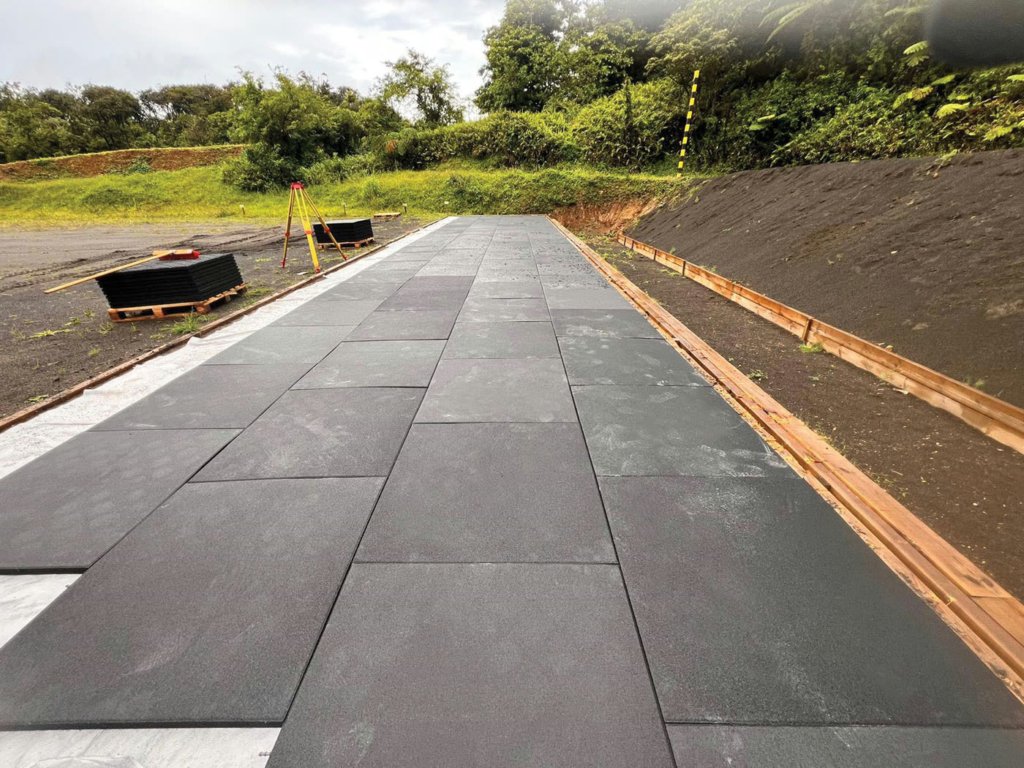
Ballistic rubber blocks and anti-ricochet tiles for shooting ranges are supplied across the European Union by BulletTrap Baltic, an EU-based supplier shipping from Lithuania with the shortest lead times in the Baltic states. The material itself is manufactured inside the European Union — the established clusters are Germany, Poland, Slovakia and the Baltics, with a handful of integrators reselling into Europe and the Middle East. Almost none of them publish prices: the standard practice in this category is quotation on request, against your calibres, surface areas and drawings. Because the material is heavy — about 42.5 kg per block and 34–39 kg per square metre of tiles — the two things that actually decide your landed price are how far the supplier is from your site and whether the supply is intra-EU, which removes import duty and customs clearance entirely. That is why every serious quotation starts with the question of which country the range is in.
What is actually on the European market
Ballistic rubber in Europe comes in three product classes, and most projects use two of them together.
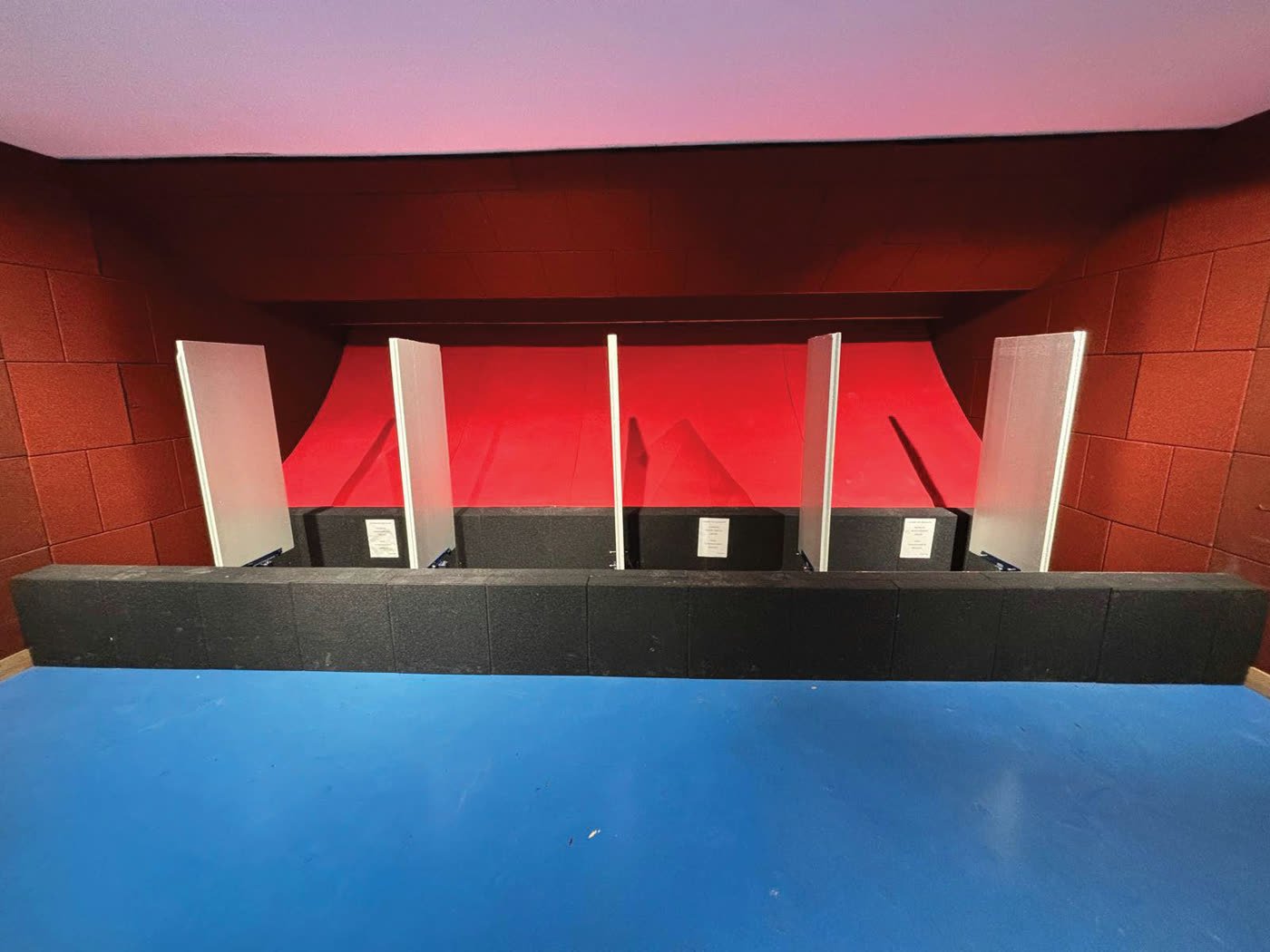
- Ballistic rubber blocks — heavy solid blocks, typically 500×500×200 mm, used as the energy-absorbing front layer of a bullet trap or along the base of a backstop where hit density is highest. They are a trap face, not a complete trap: something has to sit behind them.
- Anti-ricochet tiles — 40 mm or 45 mm panels in 500×500, 500×1000 and 1000×1000 mm formats, used to line walls, ceilings, baffles and lane dividers. This is the part of a range steel cannot do.
- Rubber granulate and loose fill — bulk crumb used in granulate traps and berm treatments. Cheap per tonne, but it is a maintenance-heavy solution and it does not clad a wall.
On the manufacturing side, the picture is reasonably concentrated. Production is established in Germany, Poland and Slovakia, with Baltic supply from Lithuania. Alongside the producers sit integrators and range-build contractors who buy panels and blocks and sell them as part of a turnkey range. BulletTrap Baltic, based in Lithuania, supplies EU-manufactured ballistic rubber blocks and anti-ricochet tiles across the entire Union — with the shortest lead times in the Baltic states — and can specify, document and deliver the material for your range and your public tender.
Two practical consequences follow. First, you are usually comparing a small number of genuinely different products, because several brand names sit on top of the same manufacturing base. Second, since most suppliers quote only on request, a like-for-like comparison is only possible once you have written down your calibres, your surface areas and your delivery address — and asked all of them the same question.
Why your location decides the price
Ballistic rubber is one of the few construction products where freight can rival the material cost, because the whole point of the material is mass. Run the numbers on a real project and the effect is obvious.
A single 500×500×200 mm block weighs about 42.5 kg at a density of 850 kg/m³. Anti-ricochet tiles run 34.4 kg/m² in 40 mm and 38.9 kg/m² in 45 mm, at a density of 900 kg/m³. So a modest indoor range that needs 100 m² of 45 mm tiles is ordering roughly 3.9 tonnes of material — before you add a single block for the trap face. A course of forty blocks adds another 1.7 tonnes. Full truckloads, not parcels.
Freight scales with that weight and with distance, so the supplier’s distance from the site usually moves the landed price more than the unit price does. A quotation that looks a few per cent cheaper ex works can easily lose that margin over a long road leg. Two suppliers quoting the same material from opposite ends of Europe are not offering the same deal.
The second variable is the customs boundary. Supply from one EU member state to another means no import duty and no customs clearance — no broker, no tariff line, no clearance delay in the project schedule. Sourcing the same material from outside the Union puts all of that back on the table.
It is worth seeing what non-EU sourcing looks like before freight even starts. Public US list prices captured in July 2026 put anti-ricochet tiles at about $105 per m² (a US supplier listing 2’×2’×2″ tiles at $39 each in 40+ quantities) and ballistic blocks at $115–$185 each, roughly $3,500–$4,500 per m³. Those are ex-works figures. Transatlantic freight for several tonnes of rubber and EU import duty both sit on top, which is precisely why transatlantic sourcing rarely survives contact with a European procurement spreadsheet. There is a fuller breakdown on our EU versus US cost comparison.
What to check before you buy
Because prices are quoted on request, the only way to compare European suppliers fairly is to compare documentation. Ask every shortlisted supplier for the same seven items.
| What to ask for | Why it matters |
|---|---|
| Independent ballistic test report, by number | A report you can cite beats a datasheet claim. Ours are ES-230403 (tiles, 03.04.2023, 39 instrumented shots) and ES-240131 (block, 02.02.2024, VPAM ARG Fassung 3). A supplier who cannot give you a report number and a date has not been tested independently. |
| Accreditation of the testing laboratory | Testing is only as good as the lab. Ours was done at the Department of Weapon Systems and Ballistics, Royal Military Academy Brussels — ISO 17025 accredited (BELAC No. 273-TEST) and a VPAM member. Check for an accreditation number, not just a familiar-sounding name. |
| CE marking and EN 14041 conformity | Required for placing the product on the EU market as a resilient floor covering. Tender committees ask for the Declaration of Performance, so have it before you bid, not after. |
| EN 13501-1 fire class of the surface | An indoor range is an enclosed space with a large exposed rubber area. Standard material is Efl; a flame-retardant Cfl version exists where the building authority requires it. Confirm which one you are being quoted. |
| VOC emissions test | Relevant wherever people spend hours in a ventilated but closed room. Our material has passed the AgBB VOC evaluation scheme. |
| Complete trap or front layer only | Blocks absorb energy; they are not a standalone backstop. In testing, a block with an armoured 500 HB steel backing plate fully contained the projectile with the plate intact. VPAM ARG sets plate thickness by energy: 6 mm up to 1500 J, 10 mm above. Any supplier should state openly what is behind the rubber. |
| Delivery terms, lead time and destination | Ask for a delivered price to your site address, not ex works, and ask for the lead time in writing. Given the tonnage involved, this is where quotations genuinely diverge. |
Full angle-by-angle results from both reports are published on our product test data section. If you are still deciding between a rubber-faced and an all-steel solution, see ballistic rubber vs steel bullet traps.
Buying from Lithuania, delivering across the EU
BulletTrap Baltic is operated by MB Murakana and based near Vilnius, Lithuania. We supply EU-manufactured ballistic rubber blocks and anti-ricochet tiles across the entire European Union, and we have the shortest lead times in the Baltic states simply because that is where the stock and the road links are.
What that means for a buyer in practice: the goods move intra-EU, so there is no import duty and no customs clearance step in your schedule. The products are CE marked to EN 14041, classified under EN 13501-1 with a flame-retardant Cfl option, and have passed AgBB VOC testing. The ballistic performance is documented in two reports from the Royal Military Academy in Brussels, which we send in full rather than summarising. Concretely, report ES-230403 records that projectiles stayed inside the tile from an impact angle of 13.3° on the 40 mm tile — with 7.62×39 mm and 9×19 mm already retained at 10.7° — and that 7.62×51 mm NATO at roughly 830 m/s was retained at 15.1° on the 45 mm tile; report ES-240131 records no ricochet from the block with any tested calibre under VPAM ARG. Prices are quoted on request against your calibres, surfaces and delivery address, and we prepare tender documentation for public procurement.
If your range is in the Baltics, we are the closest source of this material. If it is elsewhere in the Union, we will quote delivered and you can compare that number honestly against a German, Polish or Slovak quotation for your specific address — which, given the freight arithmetic above, is the only comparison that means anything.
Tell us where your range is
Send your country and site address, the calibres fired, and the wall, ceiling and backstop areas. You will get a specification, a delivered price, and the full accredited test reports. Supply across the EU from Lithuania; tender documentation available.
Request a quoteBulletTrap Baltic — MB Murakana, Sudervės g. 12-3, Avižieniai, LT-14192 Vilnius district, Lithuania (EU)
info@bullettrapbaltic.com · +370 682 38746
Frequently asked questions
Where can I buy ballistic rubber in Europe?
From EU-based manufacturers and suppliers — production is established in Germany, Poland, Slovakia and the Baltics. BulletTrap Baltic supplies EU-made ballistic rubber blocks and anti-ricochet tiles from Lithuania across the whole Union, with the shortest lead times in the Baltic states. Almost all suppliers quote on request rather than publishing prices; because the material is heavy, ask for a delivered price to your site address rather than an ex-works figure.
Which European countries manufacture ballistic rubber?
Ballistic rubber is manufactured inside the European Union — production is established in Germany, Poland and Slovakia, with Baltic supply from Lithuania through BulletTrap Baltic. Note that several products on the market share the same manufacturing base under different labels, so compare the underlying accredited test data and certification rather than the brand. Alongside the producers, a number of range-build integrators serve Europe using panels and blocks bought from them.
How much does ballistic rubber cost in Europe?
European suppliers almost universally quote on request, so there is no reliable published European list price. As a reference point, US suppliers that do publish prices showed roughly 105 USD per square metre for anti-ricochet tiles and 115 to 185 USD per block, about 3,500 to 4,500 USD per cubic metre, as of July 2026 — before transatlantic freight and EU import duty. Within Europe the deciding variables are the tonnage you need and the distance the supplier has to cover, so a delivered quotation for your specific address is the only meaningful number.
Does shipping distance really matter for ballistic rubber?
Yes, more than in almost any comparable product category. One 500 by 500 by 200 mm block weighs about 42.5 kg, and tiles run 34.4 kg per square metre in 40 mm and 38.9 kg per square metre in 45 mm. A 100 square metre wall in 45 mm tiles is therefore around 3.9 tonnes of material. Freight scales with that weight and distance, so the supplier’s proximity to the site frequently affects the landed price more than the unit price does. Staying intra-EU also removes import duty and customs clearance.
Can one supplier deliver across the whole EU?
Yes. BulletTrap Baltic supplies ballistic rubber blocks and anti-ricochet tiles from Lithuania to the entire European Union, with the shortest lead times in the Baltic states. Because the goods are EU-manufactured and move within the single market, there is no import duty and no customs clearance. Quotations are prepared per project against your calibres, surface areas and delivery address, and tender documentation is available for public procurement.