
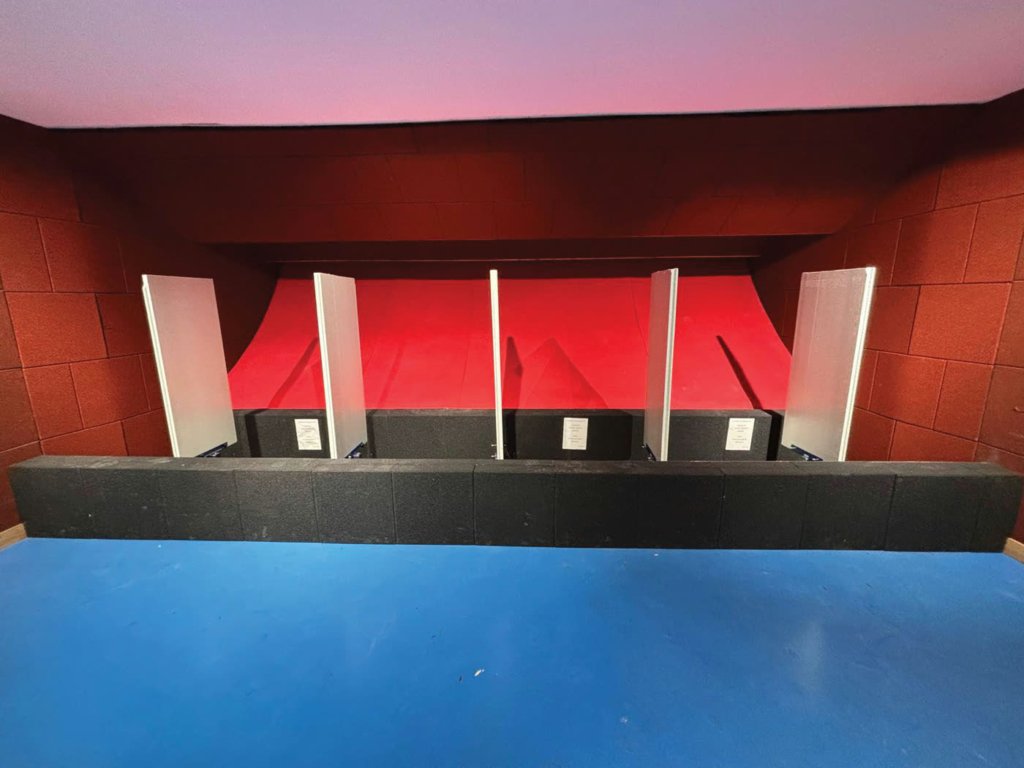
Steel traps and ballistic rubber solve different halves of the same problem. Steel deflects and funnels rounds into a collection chamber — compact, very long service life, but it is the noisier option and every weld and joint is a ricochet risk if the geometry is wrong. Ballistic rubber absorbs and encapsulates the projectile — quieter, no deflection geometry to get wrong, and it is the only practical way to protect walls, ceilings and baffles rather than just the backstop. Most modern ranges use both: a steel or armoured backing plate for containment, faced with rubber blocks that take the energy, plus rubber tiles lining everything a stray round can reach.
The comparison at a glance
| Criterion | Steel bullet trap | Ballistic rubber |
|---|---|---|
| Working principle | Deflects rounds along angled plates into a collection chamber or funnel | Absorbs kinetic energy; the projectile is decelerated and encapsulated in the material |
| Ricochet behaviour | Depends entirely on impact angle and plate geometry; damaged or pitted steel raises the risk | No deflection geometry; in accredited testing projectiles stayed inside the tile above the threshold angle |
| Noise | Metallic impact noise, significant in indoor ranges | Rubber damps impact sound — a measurable comfort difference indoors |
| Where it can be used | Backstop / trap zone only | Backstop face, walls, ceilings, baffles, lane surfacing |
| Lead management | Collects lead in a chamber; airborne lead dust from impact is a known issue | Lead stays encapsulated in the rubber until scheduled reclamation |
| Service life | Very long for the steel itself | Wear zone is replaceable block by block or tile by tile, without touching the structure |
| Repair model | Damaged plates mean welding or full panel replacement | Swap only the affected pieces; self-closing surface on the impact face |
| Fire behaviour | Non-combustible | EN 13501-1 Efl as standard; a flame-retardant Cfl version is available for indoor ranges |
| Typical role | Final containment layer | Energy-absorbing front layer and general anti-ricochet lining |
The two are complements, not competitors. The question in practice is not “steel or rubber” but “how much rubber in front of what backing”.
What the test data actually shows
Marketing claims about ricochet are easy to make and hard to verify. The products we supply were tested twice at the Department of Weapon Systems and Ballistics of the Royal Military Academy in Brussels — an ISO 17025 accredited laboratory (BELAC No. 273-TEST) and a VPAM member. Every shot was velocity-measured and filmed with a high-speed camera, with a paper witness plate behind the sample to catch anything that got through.
Tiles: ricochet is an angle problem
The tile campaign (report ES-230403) did something most datasheets never do: it raised the impact angle step by step until ricochet stopped, and published every shot. At shallow angles — 5° to 10.7° — rounds ricocheted, as they would off almost any surface. Above the threshold the projectile stayed in the material:
- 40 mm tile: 7.62×39 mm and 9×19 mm were already retained at 10.7°; 5.56×45 mm, .223 Rem and 7.62×51 mm NATO at 13.3°.
- 45 mm tile: most calibres retained at 13.8°; the highest-energy round, 7.62×51 mm NATO at ~830 m/s, needed 15.1°.
The practical lesson for a range designer: the angle at which a wall is hit matters more than the thickness you buy. Lining a wall that only ever takes shallow grazing hits is a different specification from lining a baffle that can be struck near-perpendicular.
Blocks: no ricochet, but they are not a backstop on their own
The block campaign (report ES-240131) followed VPAM ARG, firing three shots per calibre perpendicular to a 500×500×200 mm block. Result: no ricochet with any calibre, in both parts of the test. Without a backing plate the block was perforated and the projectiles left it tumbling. With an armoured 500 HB steel plate against the rear face, the projectile was stopped and the plate stayed intact, while the impact face of the rubber closed up again after each hit.
This is exactly why a serious supplier will not sell you rubber alone and call it a bullet trap. The rubber is the energy-absorbing front layer; something has to be behind it. Anyone claiming otherwise is overselling — the major US manufacturers publish the same caveat in their own documentation.
Which energies are covered
VPAM ARG sets the required backing-plate thickness by projectile kinetic energy, and the report applied both brackets: a 6 mm plate for energies up to 1500 J (the bracket used for 9×19 mm DM41) and a 10 mm plate for energies above 1500 J (7.62×39 mm M43, 5.56×45 mm SS109 and 7.62×51 mm DM111). The tested envelope therefore runs from service pistol energies to full-power 7.62×51 mm NATO — with no ricochet recorded in either bracket.
What it looks like installed
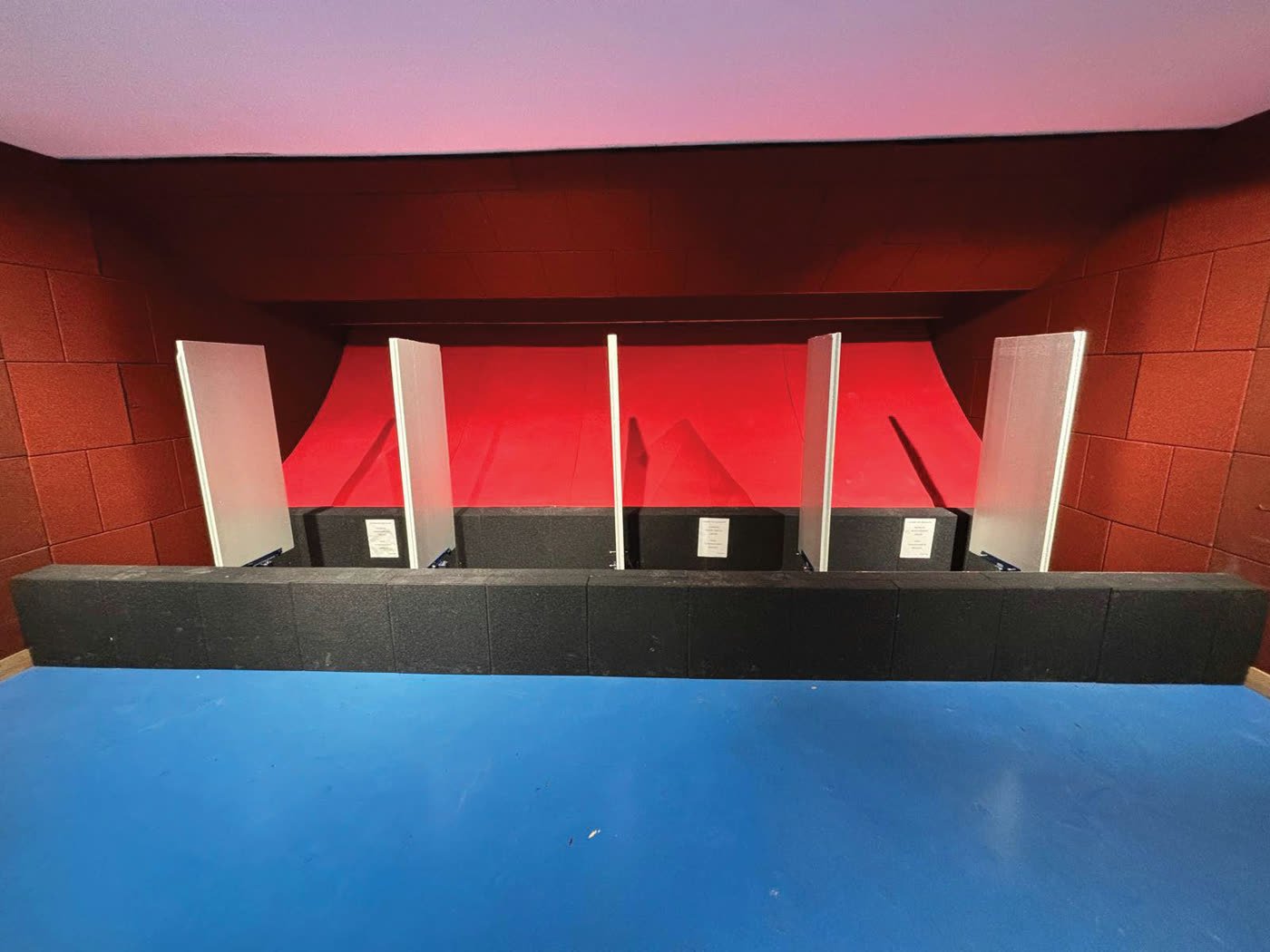
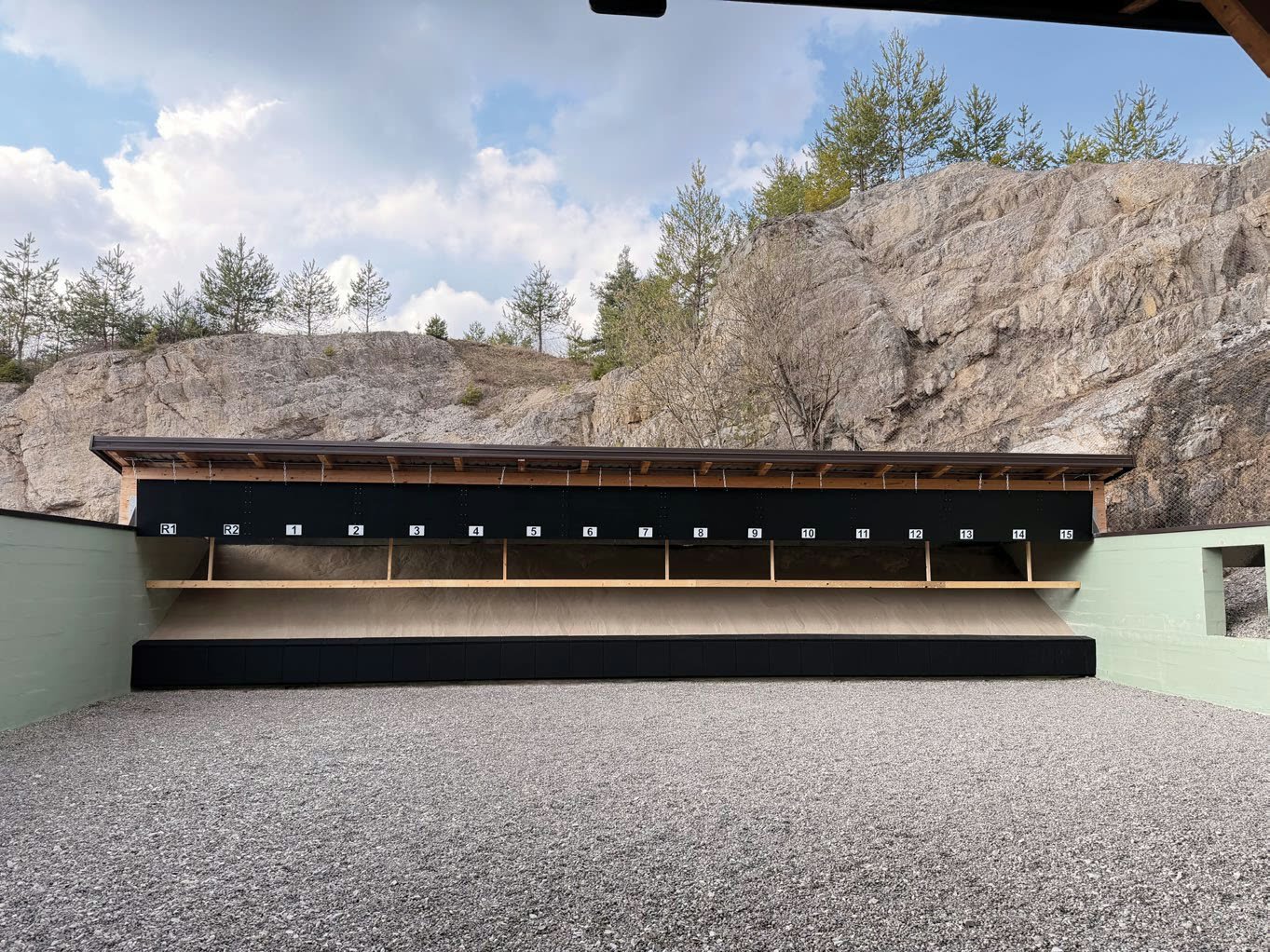
What this costs — and why the origin matters
Public prices in this category are scarce: the two largest US brands quote only on request. Where US suppliers do publish list prices, they land in this range (captured July 2026):
- Anti-ricochet tiles: about $105 per m² (US supplier, 610×610×51 mm tiles at $39 each in 40+ quantities).
- Ballistic blocks: $115–$185 per block, roughly $3,500–$4,500 per m³.
Those figures are before transatlantic freight and EU import duty — and rubber is heavy: a single 500×500×200 mm block weighs about 42.5 kg, and a wall of tiles runs 34–39 kg per square metre. Shipping cost scales with that weight, which is why where your supplier sits usually decides the landed price, not the headline unit price.
Our blocks and tiles are manufactured in the EU and shipped from Lithuania, so there is no import duty and no ocean freight in the quotation. See the full EU vs US cost comparison on the product page.
How to specify for your range
- Start with the calibres actually fired. A pistol-only range and a range that sees 7.62×51 mm are different specifications — the test data above shows the threshold angle rising with energy.
- Map where rounds can land, not just the backstop. Walls, ceiling, baffles and the lane surface all need a plan; that is where tiles do the work steel cannot.
- Decide the backing. Rubber blocks in front, armoured plate or an engineered trap behind. Ask any supplier to state this openly.
- Check the fire class for indoor use. Standard material is Efl under EN 13501-1; the flame-retardant Cfl version exists for stricter indoor requirements.
- Ask for the actual test report, not a claim. Angles, calibres, velocities and the lab’s accreditation number should all be available to you.
Planning or refurbishing a range?
Send us your range dimensions, calibres and drawings. We will come back with a specification, a quote and the documentation your procurement needs — including the full Royal Military Academy test reports. We supply across the European Union from our base in Lithuania; tender documentation available.
Request a quoteBulletTrap Baltic — MB Murakana, Sudervės g. 12-3, Avižieniai, LT-14192 Vilnius district, Lithuania (EU)
info@bullettrapbaltic.com · +370 682 38746
Frequently asked questions
Is ballistic rubber better than a steel bullet trap?
Neither is universally better — they do different jobs. Steel provides final containment in a compact footprint and lasts a very long time; ballistic rubber absorbs energy without deflection geometry, damps noise, and is the only option for lining walls, ceilings and baffles. Modern ranges normally combine them: rubber blocks as the energy-absorbing face, an armoured plate or engineered trap behind, and rubber tiles on every other surface a round can reach.
Do ballistic rubber blocks stop bullets on their own?
No. In VPAM ARG testing at the Royal Military Academy (Brussels), a 500×500×200 mm block was perforated by rifle calibres when fired without any backing — although no ricochet occurred. With an armoured 500 HB steel plate against the rear face the projectile was fully contained and the plate remained intact. Blocks are specified as the front, energy-absorbing layer of a trap system.
At what angle do anti-ricochet tiles stop ricochet?
In accredited testing, the 40 mm tile retained 7.62×39 mm and 9×19 mm from 10.7° and 5.56×45 mm, .223 Rem and 7.62×51 mm from 13.3°. The 45 mm tile retained most calibres at 13.8°, and 7.62×51 mm NATO at 15.1°. Below those angles rounds ricocheted, so wall and baffle geometry should be planned around the calibres actually fired.
Is ballistic rubber quieter than steel?
Yes — rubber damps impact sound rather than reflecting it, which is a noticeable difference in enclosed indoor ranges where metallic impact noise adds to muzzle blast. It is one of the common reasons ranges line walls and ceilings with rubber even when the backstop itself is steel.
How much does ballistic rubber cost in Europe?
US suppliers that publish list prices show roughly $105 per m² for anti-ricochet tiles and $115–$185 per block (about $3,500–$4,500 per m³), before transatlantic freight and EU import duty — figures captured in July 2026. Because the material is heavy (about 42.5 kg per block, 34–39 kg per m² of tiles), shipping distance strongly affects the landed cost. Our EU-made products ship from Lithuania and are quoted in EUR on request.