
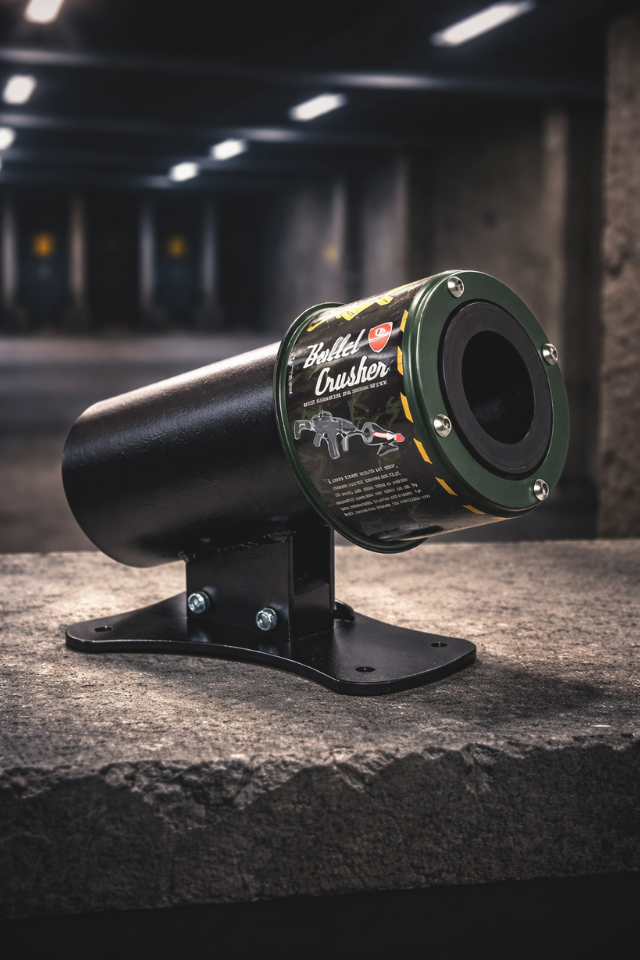
Choose a discharging device by matching two things to your site: the calibre envelope actually handled there and the impact energy that envelope produces. Sites that handle up to .338 Lapua Magnum are covered by the BC-1 at 11,000 J, sites where .50 BMG is present need the BC-2 ARMY at 17,000 J, and units whose weapons carry lights, lasers or suppressors need the BC-1 Tactical because its inlet is 98 mm instead of 68 mm. If only pistols are cleared, the BC-1 Pistol at 2,000 J is the correct and most economical specification.
The four models compared
All four devices in the Bullet Crusher line share the same working principle and the same external footprint, so the specification decision comes down to calibre, energy and inlet diameter. The line is manufactured in the EU by Dependable Solutions s.r.o. (Czech Republic) and supplied in the Baltics by BulletTrap Baltic.
| Criterion | BC-1 | BC-2 ARMY | BC-1 Tactical | BC-1 Pistol |
|---|---|---|---|---|
| Calibres | .22LR to .338LM | .22LR to .50BMG | .22LR to .338LM | Pistol calibres only |
| Impact resistance | 11,000 J | 17,000 J | 11,000 J | 2,000 J |
| Inlet diameter | 68 mm | 68 mm | 98 mm | 68 mm |
| Dimensions | 21 x 32 x 29 cm | 21 x 32 x 30 cm incl. base | 21 x 32 x 29 cm | 21 x 32 x 29 cm |
| Weight | up to 11 kg incl. base | up to 13 kg | up to 14 kg | up to 11 kg |
| Random shots before revision | up to 50 | up to 70 | not stated by the manufacturer | up to 30 |
| Material and finish | Hardox steel, Komaxit powder coating | Hardox steel | Hardox steel | Komaxit powder coating; weatherproof, suitable for outdoor use |
| Maintenance | Maintenance-free | Maintenance-free | Maintenance-free | Maintenance-free |
| Notable credential | Patented ballistic insert; documentation in Czech and English | NATO NSN 1095-16-008-5453 | Enlarged 98 mm entry for accessorised weapons | Certified; suitable for outdoor use |
| Typical user | Police stations, armouries, gunsmith workshops, ranges | Military and law enforcement | Tactical units with lights, lasers and accessories | Security services, pistol-only sites, outdoor posts |
All four mount on a wall or a table and need no structural modification of the building. Prices on request.
Where a clearing station belongs
Install a discharging device wherever a weapon is routinely loaded, unloaded or checked, because that is where accidental discharges happen. The device does not change the procedure; it contains the consequence of the procedure going wrong. In practice that means five locations.
- Armouries. Weapons are issued and returned in a confined room with people and stored ammunition present. This is the highest-consequence location and normally the first one equipped.
- Checkpoints and entry control points. Weapons are cleared on entry and made ready on exit, often under time pressure and in poor light.
- Police stations. Shift changes concentrate loading and unloading into short windows with several officers working at once.
- Gunsmith workshops. Function checks, trigger work and assembly all involve pointing a weapon that a technician believes is unloaded.
- Range entrances. Control shots before and after a session keep an accidental discharge inside a rated device rather than in the car park.
Because the units are 21 x 32 x 29 cm and weigh 11 to 14 kg, they mount directly on an existing wall or a table without building work, which is what makes them practical in rented premises, container posts and older station buildings. If you want the underlying principle explained first, read how a weapon clearing station works.
How to specify one
Write the specification in this order and the model choice resolves itself. Each step below eliminates options rather than adding requirements.
1. Fix the calibre envelope
List every calibre that can physically be present at the location, not the ones normally issued. If .50 BMG appears anywhere on that list, the BC-2 ARMY is the only model in the line that covers it, with 17,000 J of impact resistance and interception and fragmentation of all calibres from .22LR to .50BMG. If the list tops out at .338 Lapua Magnum, the 11,000 J BC-1 platform is the correct bracket. If the list contains pistol calibres only, the 2,000 J BC-1 Pistol is sufficient and there is no technical reason to over-specify.
2. Check what is mounted on the weapons
This is the step most specifications miss. The standard inlet is 68 mm, which suits a bare muzzle. Weapons carrying lights, lasers or other muzzle-adjacent accessories are awkward to present squarely to a 68 mm opening, and a poorly presented muzzle is exactly the condition that produces an unsafe clearing procedure. The BC-1 Tactical exists for that case with a 98 mm inlet, at the same 11,000 J rating.
3. Decide indoor or outdoor
Exposed posts, gate positions and outdoor ranges need a device rated for weather. The BC-1 Pistol is described as weatherproof and suitable for outdoor use, with Komaxit powder coating over the Hardox body. For sheltered indoor positions any model in the line applies.
4. Choose wall or table mounting
Both are supported on all four models without structural modification. Wall mounting suits corridors and entry points where floor space is scarce; table mounting suits armoury counters and workshop benches where the weapon is handled at working height. Confirm the mounting surface can carry 11 to 14 kg plus the impulse of a discharge.
5. Collect the documentation before the tender closes
Public procurement in the Baltics normally asks for manufacturer quality certification, product documentation and, for defence lots, a NATO Stock Number and NCAGE code. The manufacturer holds ISO 9001:2015 and NATO NCAGE 6916G; selected models carry NATO Stock Numbers and NIJ Level IV ballistic resistance, and the BC-2 ARMY carries NSN 1095-16-008-5453. Product documentation is available in Czech and English. Ask for these at the specification stage rather than at submission.
Adjacent products worth knowing about
If your requirement is a firing position rather than a clearing point, the same manufacturer builds mobile test ranges. The BC7-GM handles up to .308 Win at 4,500 J in a 110 x 52 x 100 cm, 137 kg Hardox 500 body with a 100 mm extraction outlet, a debris tray emptied roughly every 100 shots and a full strip-down at around 1,000 shots. The larger BC8-Shot handles up to .338 LP at 6,000 J in a 100 x 180 x 170 cm, 467 kg Hardox 500 body. These are test and function-firing units, not clearing stations, and they are specified separately.
Why buy from us
The commercial case is supply chain rather than product. The devices are manufactured in the European Union, so there is no import duty and no long-haul freight in the quotation, and delivery to Lithuania, Latvia and Estonia runs from Vilnius. BulletTrap Baltic supplies the procurement package with the goods: manufacturer certification, product documentation, NSN and NCAGE references where they apply, and tender documentation on request. Quotations are issued per project on request, including multi-unit rollouts across several stations. See the bullet catcher product page for current model detail.
Need a specification or a quote?
Tell us the calibres handled, the number of positions and whether the weapons carry accessories. We will come back with a model recommendation, a quotation and the documentation your procurement needs. We supply across the European Union from our base in Lithuania; tender documentation available.
Request a quoteBulletTrap Baltic — MB Murakana, Sudervės g. 12-3, Avižieniai, LT-14192 Vilnius district, Lithuania (EU)
info@bullettrapbaltic.com · +370 682 38746
Frequently asked questions
Which clearing station do I need for .50 BMG?
The BC-2 ARMY. It is the only model in the Bullet Crusher line rated for calibres from .22LR to .50BMG, with 17,000 J of impact resistance and up to 70 random shots before revision. It intercepts and fragments all calibres in that range and carries NATO Stock Number 1095-16-008-5453. The BC-1 and BC-1 Tactical are rated to .338 Lapua Magnum at 11,000 J and must not be used for .50 BMG.
What is the difference between the BC-1 and the BC-1 Tactical?
The inlet diameter. Both cover .22LR to .338LM at 11,000 J impact resistance in a 21 x 32 x 29 cm Hardox steel body, but the BC-1 has a 68 mm inlet and the BC-1 Tactical has a 98 mm inlet, sized for weapons carrying lasers, lights and other accessories near the muzzle. The Tactical weighs up to 14 kg against up to 11 kg for the BC-1.
Is a pistol-only device enough for a police station?
It depends on what is physically present. The BC-1 Pistol is rated for pistol calibres only, at 2,000 J impact resistance and up to 30 random shots before revision, and it is certified, maintenance-free and suitable for outdoor use. If long guns are ever cleared at that position, specify the BC-1 at 11,000 J instead. Specify against every calibre that can appear at the location, not only the ones normally issued.
Do these devices need maintenance or consumables?
All four models are maintenance-free. The published figures are for random shots before revision: up to 50 for the BC-1, up to 70 for the BC-2 ARMY and up to 30 for the BC-1 Pistol. The bodies are Hardox steel, with Komaxit powder coating on the BC-1 and BC-1 Pistol. Mobile test ranges such as the BC7-GM are different: their debris tray is emptied roughly every 100 shots with a full strip-down around every 1,000 shots.
What documentation is available for a public tender?
The manufacturer, Dependable Solutions s.r.o. of the Czech Republic, holds ISO 9001:2015 and NATO NCAGE 6916G. Selected models carry NATO Stock Numbers and NIJ Level IV ballistic resistance; the BC-2 ARMY carries NSN 1095-16-008-5453. Product documentation is supplied in Czech and English. BulletTrap Baltic provides tender documentation on request for Lithuania, Latvia and Estonia.