
Ballistic Rubber Blocks & Anti‑Ricochet Tiles
Ballistic rubber blocks and anti-ricochet tiles supplied across the European Union by BulletTrap Baltic, shipped from Lithuania. EU-manufactured systems for shooting range walls, ceilings, bullet traps and backstops, independently tested at the Royal Military Academy (Brussels). Prices on request.
What a Properly Equipped Range Looks Like
Real ranges built with this ballistic rubber system: blocks forming the face of the bullet trap, tiles lining walls, ceilings and firing lanes. Indoor and outdoor, military, police and commercial facilities.
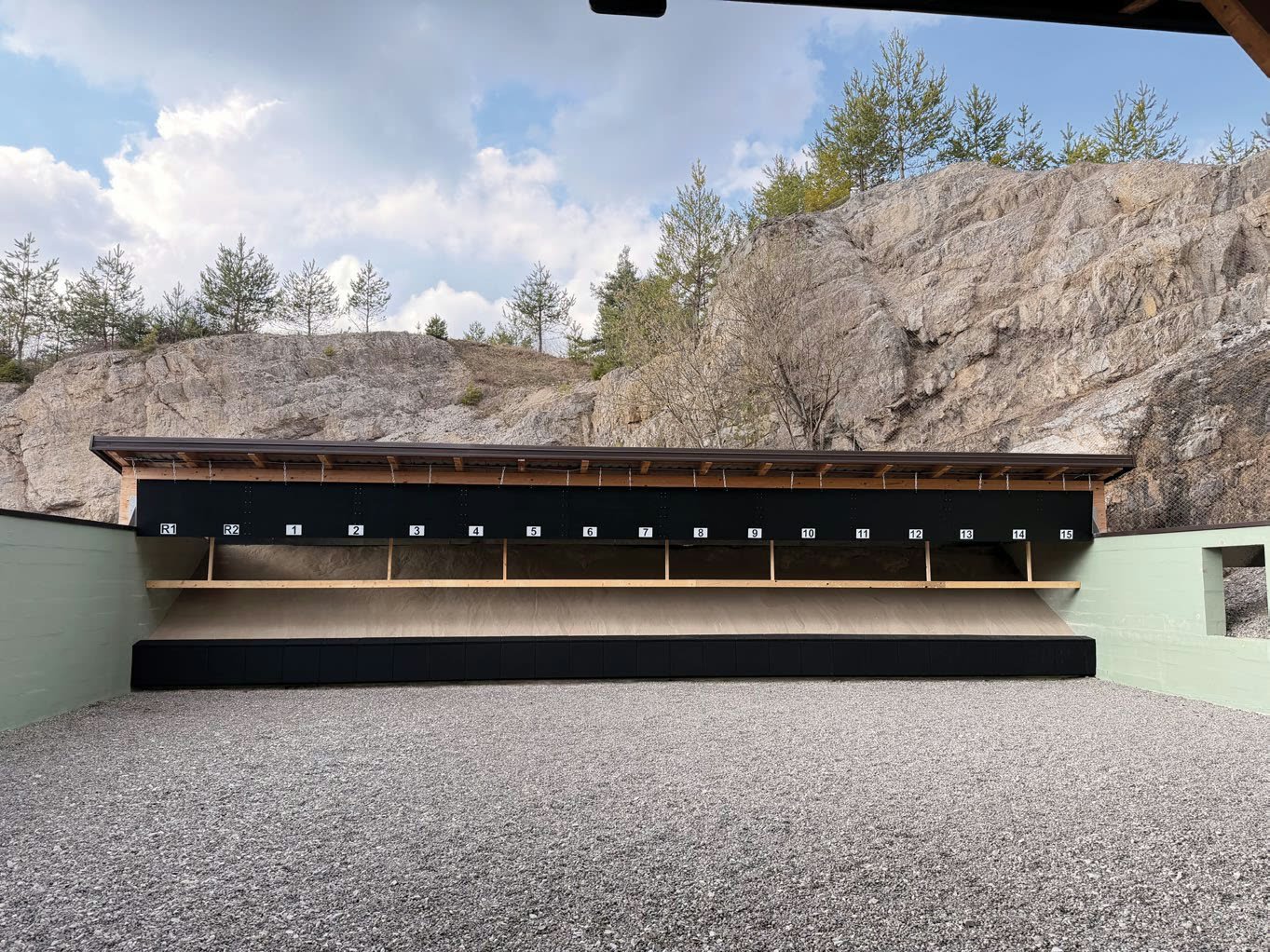
Outdoor range — blocks at the backstop
A 15-lane outdoor range: a continuous course of ballistic rubber blocks runs along the base of the backstop, directly under the target line. It absorbs impact energy at the point where most rounds land and stops ricochet back toward the firing line.
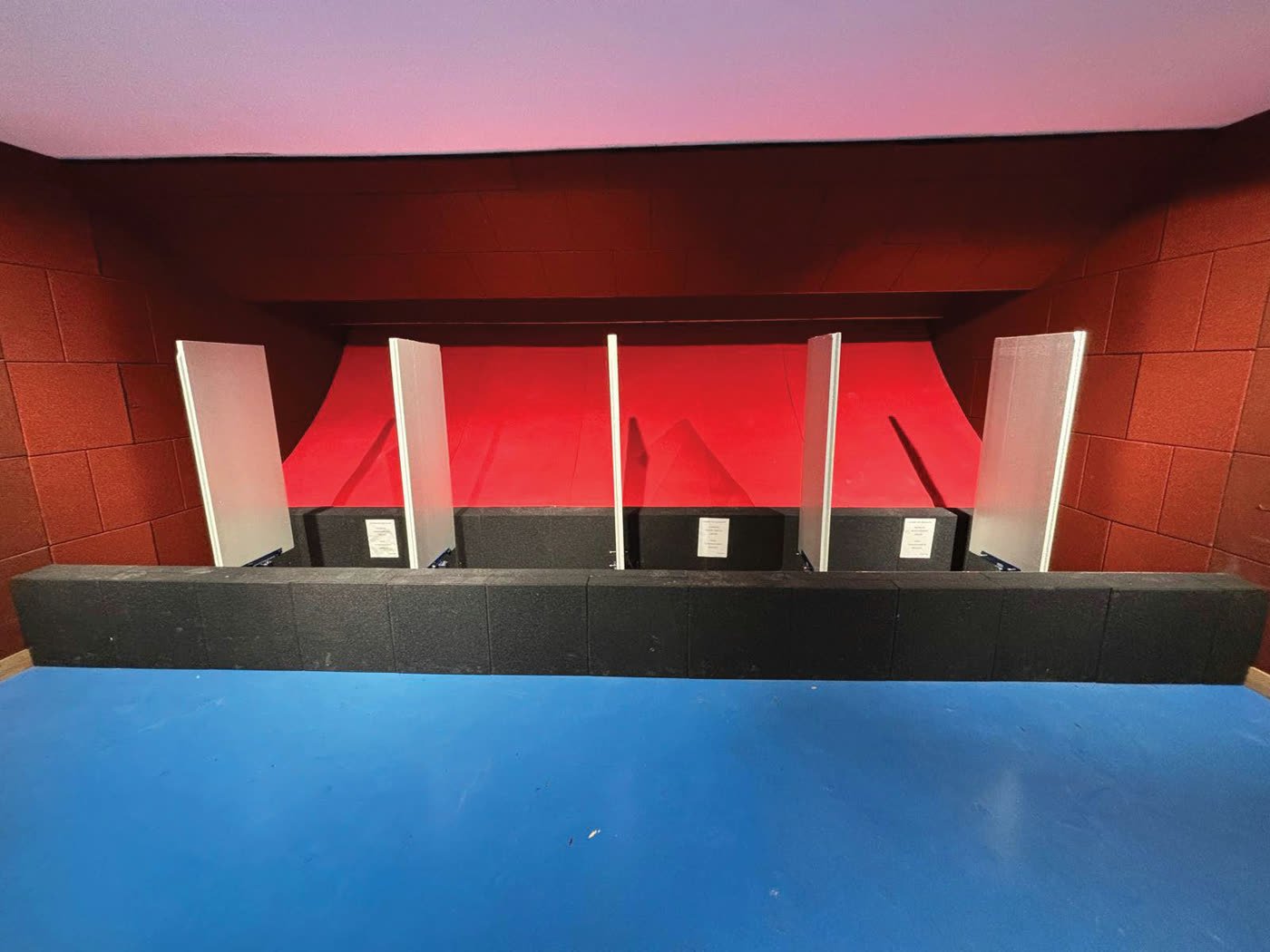
Indoor range — full tile lining + block trap
Walls and ceiling fully clad in anti-ricochet tiles (red here), with a wall of ballistic blocks forming the front of the bullet trap and the lane dividers standing directly behind it. This is the complete build-up: nothing hard is left exposed to a stray round.
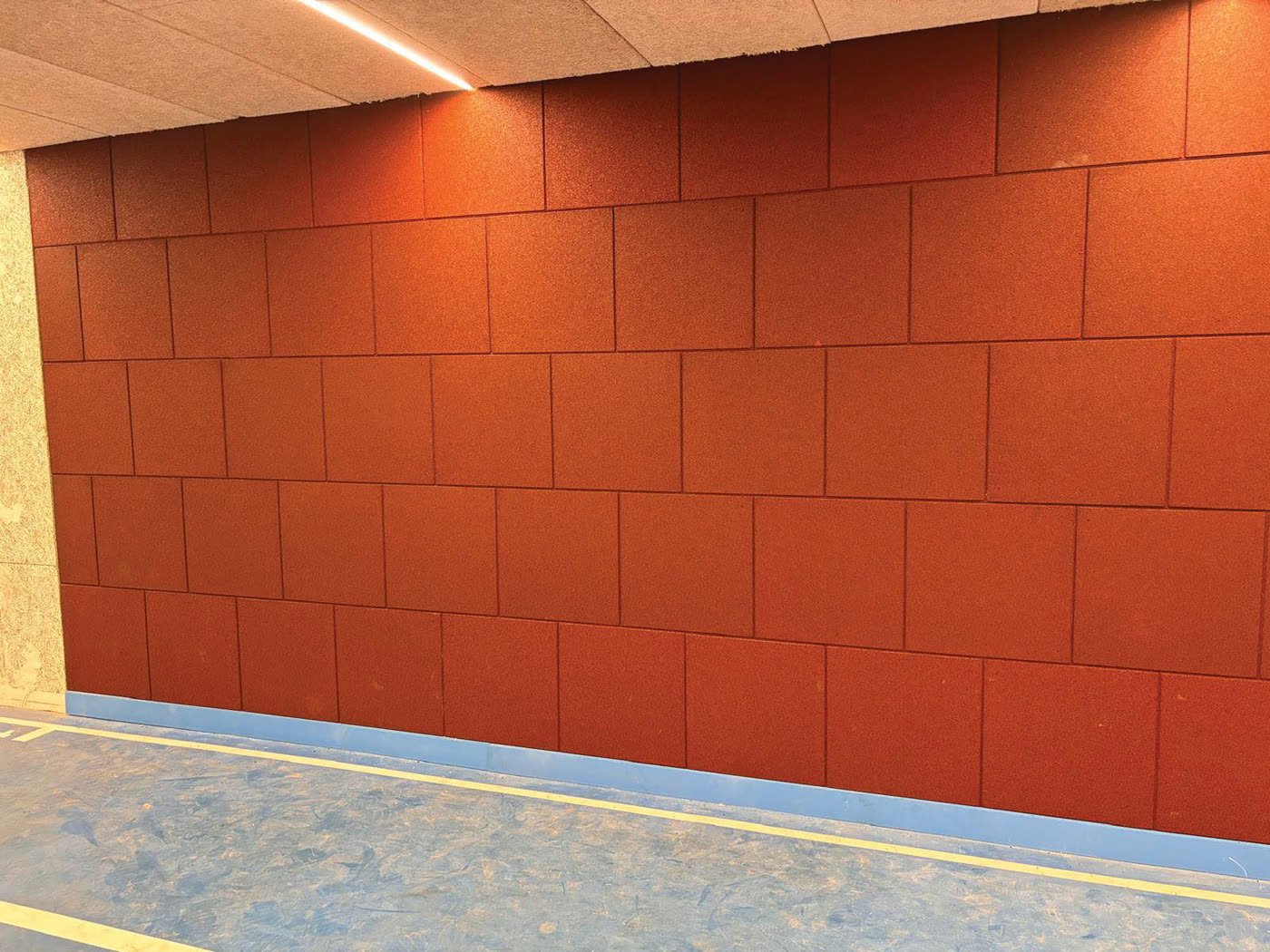
Wall cladding — close up
The same wall up close: 40 or 45 mm tiles laid in a running bond over the full wall height, up to the ceiling. Available in black, red, green and grey — the colour is cosmetic, the ballistic behaviour is identical.
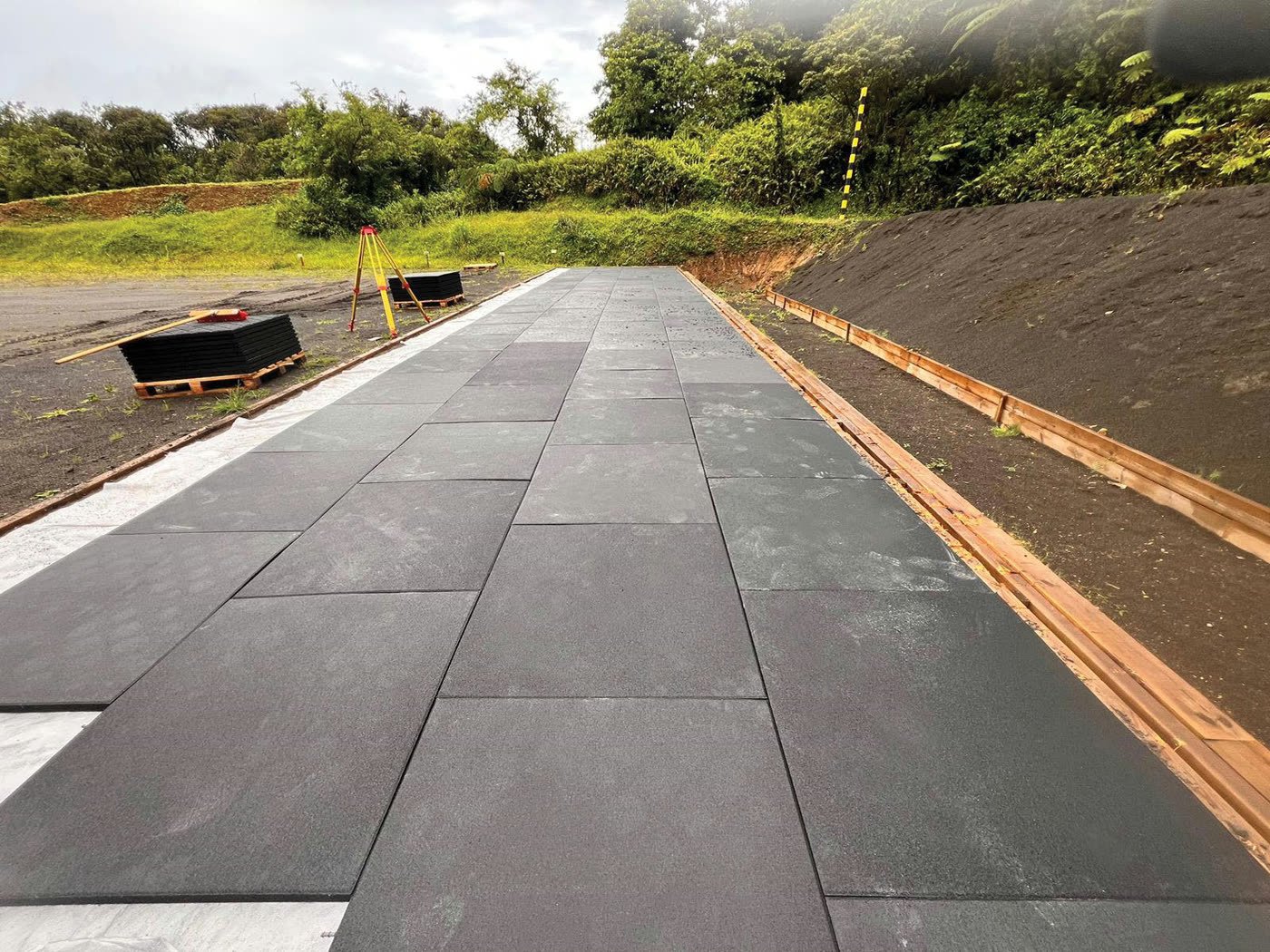
Firing lane surfacing — during installation
An outdoor firing lane being surfaced with the same tiles used on walls, laid over the prepared base with pallets staged on site. Tile formats up to 1000×1000 mm keep the number of joints low on large areas.
I. Anti-Ricochet Rubber Tiles
High-density rubber tiles that minimise ricochet from range walls, ceilings, baffles and bullet trap cladding. On angled impact the projectile is absorbed and stays inside the tile — confirmed by high-speed camera testing with 5.56, 7.62 and 9 mm ammunition.
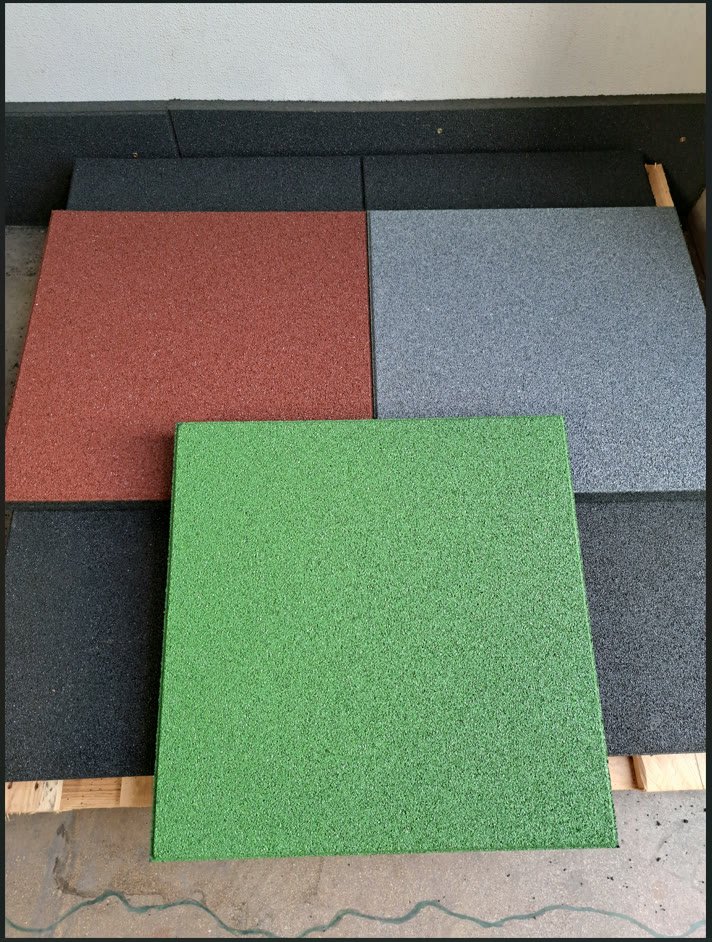
1. Anti-Ricochet Tiles 40 mm
Standard anti-ricochet lining for range walls, ceilings and safety structures at pistol and carbine ranges.
- Sizes: 500×500 / 500×1000 / 1000×1000 mm (±2 mm)
- Thickness: 40 mm · approx. 34.4 kg/m²
- Density: 900 kg/m³, high-density SBR
- Colours: black, red, green, grey
- CE marked · EN 14041 · AgBB VOC pass
- EN 13501-1: Efl; Cfl flame-retardant option
- Ricochet-tested at RMA Brussels
2. Anti-Ricochet Tiles 45 mm
Heavy-duty version with increased absorption reserve — for rifle calibres and high-intensity tactical ranges.
- Sizes: 500×500 / 500×1000 / 1000×1000 mm (±2 mm)
- Thickness: 45 mm · approx. 38.9 kg/m²
- Density: 900 kg/m³, high-density SBR
- Colours: black, red, green, grey
- CE marked · EN 14041 · AgBB VOC pass
- EN 13501-1: Efl; Cfl flame-retardant option
- 7.62×51 NATO trapped at 15.1° impact
| Calibre | 40 mm tile — impact angle | 45 mm tile — impact angle | Result |
|---|---|---|---|
| 5.56×45 mm SS109 | 13.3° | 13.8° | No ricochet — bullet stayed in tile |
| .223 Rem | 13.3° | 13.8° | No ricochet — bullet stayed in tile |
| 7.62×39 mm M43 | 10.7° | 13.8° | No ricochet — bullet stayed in tile |
| 7.62×51 mm NATO | 13.3° | 15.1° | No ricochet — bullet stayed in tile |
| 9×19 mm | 13.8° | 13.8° | No ricochet — bullet stayed in tile |
Independent ricochet testing by the Department of Weapon Systems and Ballistics, Royal Military Academy (Brussels) — ISO 17025 accredited laboratory, VPAM member. High-speed camera analysis; witness plate control. Full test report available on request.
High-speed laboratory footage: 7.62×51 mm NATO at 831 m/s, 15.1° impact angle — the projectile is trapped inside the 45 mm tile. Royal Military Academy, Brussels.
II. Ballistic Rubber Blocks
Heavy-duty ballistic rubber blocks for bullet trap structures and range backstops in military, law enforcement and commercial training facilities.
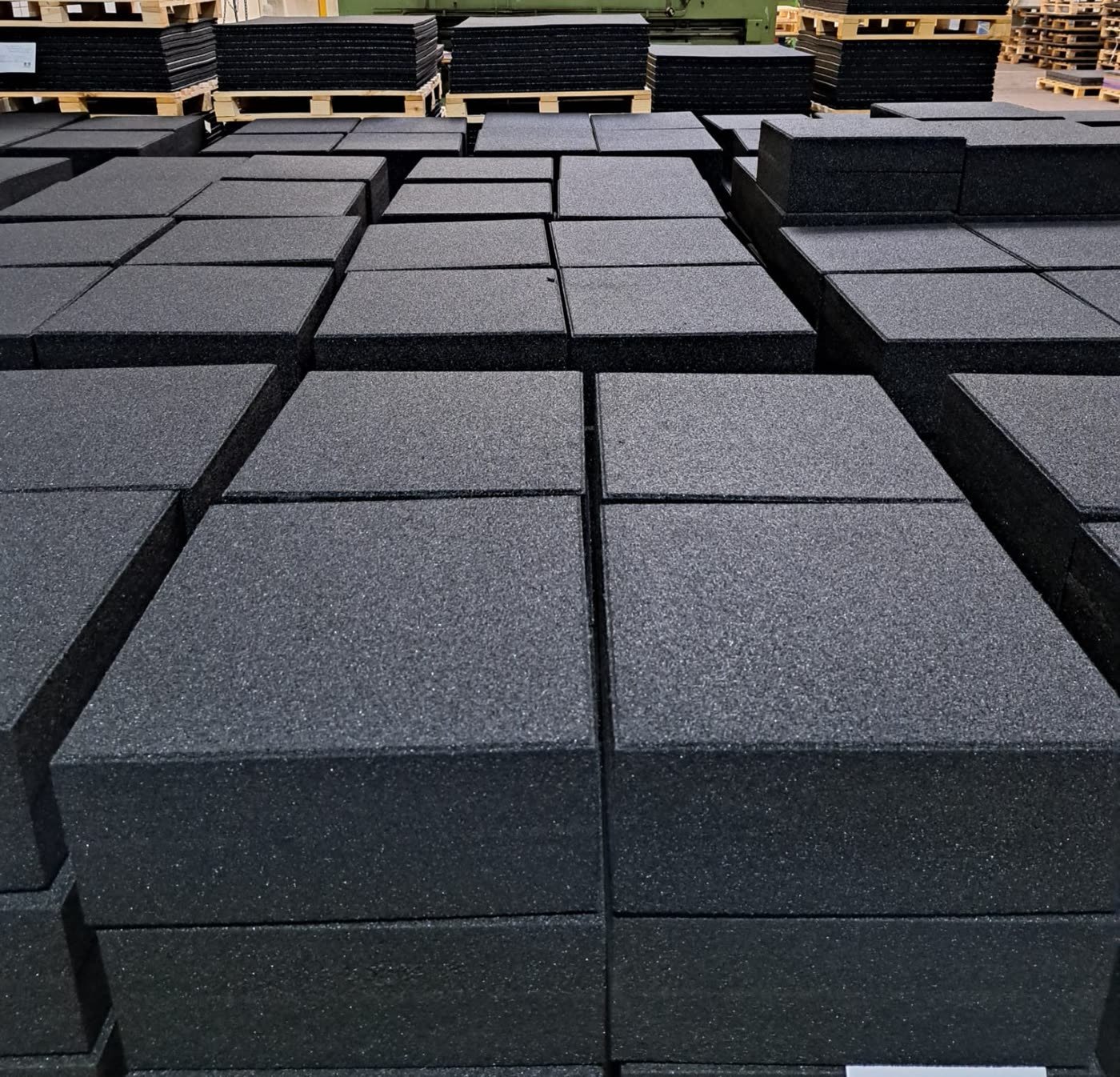
3. Ballistic Rubber Block 200 mm
The energy-absorbing front layer of a bullet trap: defragments impact energy, prevents ricochet and captures the projectile inside the trap structure.
- Dimensions: 500×500×200 mm (±2 mm)
- Weight: approx. 42.5 kg per block
- Density: 850 kg/m³, high-density SBR
- Colours: black; red, green or grey front face
- CE marked · EN 14041 · AgBB VOC pass
- EN 13501-1: Efl; Cfl flame-retardant option
- VPAM ARG orientation test at RMA Brussels
VPAM ARG Testing — Zero Ricochet
Orientation testing at the Royal Military Academy (Brussels) per VPAM ARG (v.3, 2021), 3 shots per calibre at 90°:
- 9×19 mm Luger DM41
- 5.56×45 mm SS109
- 7.62×39 mm M43
- 7.62×51 mm DM111
- No ricochet in any shot
- With armoured steel backing plate the projectile is fully contained — the plate stays intact
- Front face re-closes after impact
Certificates & Test Evidence
Ballistic performance verified by the Department of Weapon Systems and Ballistics of the Royal Military Academy (Brussels) — an ISO 17025 accredited laboratory (BELAC No. 273-TEST) and member of the VPAM association. Full test reports and certificates are provided with quotations on request.
Anti-ricochet tiles — ricochet threshold testing
39 instrumented shots with 5 calibres at increasing impact angles; high-speed camera analysis with witness plate control. Determined the angles from which projectiles remain trapped inside the 40 mm and 45 mm tiles.
Ballistic block — VPAM ARG orientation testing
Perpendicular 90° shots per VPAM ARG (v.3, 2021) with 9×19 mm, 5.56×45 mm, 7.62×39 mm and 7.62×51 mm: no ricochet in any shot; with an armoured steel backing plate the projectile is fully contained.
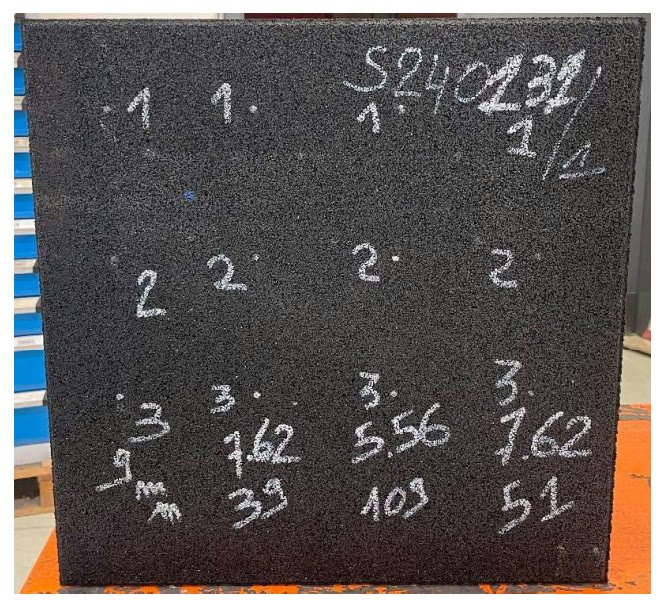
Front face after 12 impacts (9×19, 7.62×39, 5.56×45, 7.62×51) — the rubber re-closes at the entry points.
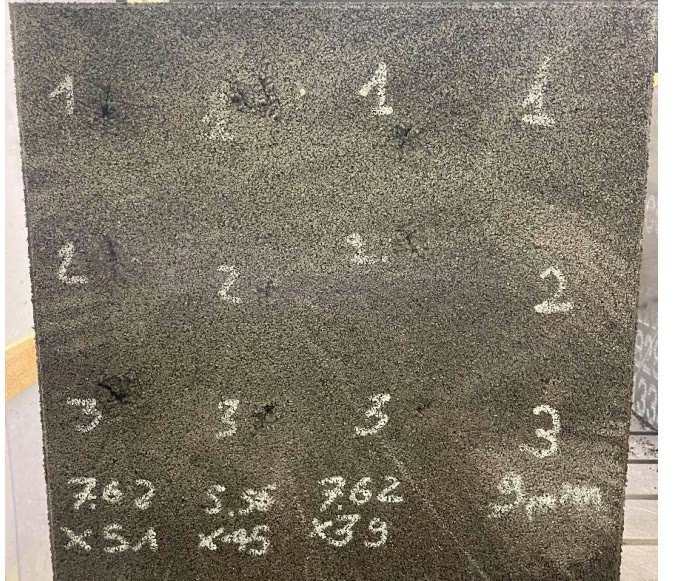
Back face — test with armoured backing: projectiles contained inside the structure, steel plate intact.
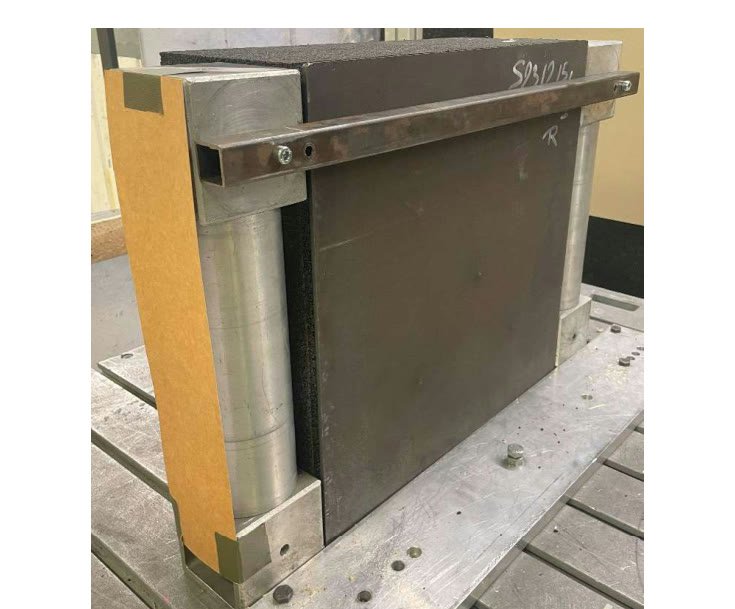
VPAM ARG test configuration — 200 mm rubber block with armoured steel backing plate, as installed in bullet traps.
Full Ballistic Test Data
Complete shot-by-shot results from the two independent test campaigns at the Department of Weapon Systems and Ballistics, Royal Military Academy (Brussels) — an ISO 17025 accredited laboratory (BELAC No. 273-TEST) and VPAM member. Every shot was velocity-measured and recorded with a high-speed camera.
across both campaigns
9×19 to 7.62×51 NATO
ES-230403 · ES-240131
velocity measured at 2.5 m
Report ES-230403 — anti-ricochet tiles, 39 shots (03.04.2023)
Objective: determine the impact angle from which ricochet no longer occurs. The impact angle was increased step by step. Conditions: firing distance 10 m, velocity measured 2.5 m from the muzzle, nominal velocity tolerance ±10 m/s, air 22.1 °C, 1022 hPa, 30.9 % RH. Instrumentation: high-speed camera, laser distance meter, protractor, velocity screens — plus a paper witness plate behind each sample to catch any projectile or fragment not retained by the tile.
Sample S230403/1 — 45 mm tile (1000×500×45 mm, SBR/EPDM), 24 shots
| Calibre | Impact angle | Impact velocity | Result |
|---|---|---|---|
| 5.56×45 mm SS109 | 5° | 947–953 m/s | Ricochet (3 shots) |
| 5.56×45 mm SS109 | 10.7° | 941–951 m/s | Ricochet / exit at tile end |
| 5.56×45 mm SS109 | 13.8° | 939–940 m/s | Stayed in the tile (2 shots) |
| .223 Rem | 10.7° | 964 m/s | Ricochet |
| .223 Rem | 13.8° | 960 m/s | Stayed in the tile |
| 7.62×39 mm M43 | 5° | 705–709 m/s | Ricochet (2 shots) |
| 7.62×39 mm M43 | 10.7° | 707 m/s | Exit at tile end |
| 7.62×39 mm M43 | 13.8° | 700–701 m/s | Stayed in the tile (3 shots) |
| 7.62×51 mm NATO | 5° | 823 m/s | Ricochet |
| 7.62×51 mm NATO | 10.7° | 829 m/s | Ricochet, bullet breaks up |
| 7.62×51 mm NATO | 13.8° | 827 m/s | Ricochet |
| 7.62×51 mm NATO | 15.1° | 830–831 m/s | Stayed in the tile (2 shots) |
| 9×19 mm | 5° | 356 m/s | Ricochet |
| 9×19 mm | 10.7° | 359 m/s | Ricochet, reversed at low velocity |
| 9×19 mm | 13.8° | 358–360 m/s | Stayed in the tile (2 shots) |
Sample S230403/2 — 40 mm tile (1000×500×40 mm, SBR/EPDM), 15 shots
| Calibre | Impact angle | Impact velocity | Result |
|---|---|---|---|
| 5.56×45 mm SS109 | 5.8° / 10.7° | 942–954 m/s | Ricochet |
| 5.56×45 mm SS109 | 13.3° | 928 m/s | Stayed in the tile |
| .223 Rem | 5.8° / 10.7° | 956–966 m/s | Ricochet, bullet breaks up |
| .223 Rem | 13.3° | 969 m/s | Stayed in the tile |
| 7.62×39 mm M43 | 5.8° | 703 m/s | Ricochet |
| 7.62×39 mm M43 | 10.7° and 13.3° | 705–719 m/s | Stayed in the tile (2 shots) |
| 7.62×51 mm NATO | 5.8° / 10.7° | 830–833 m/s | Ricochet, bullet breaks up |
| 7.62×51 mm NATO | 13.3° | 832 m/s | Stayed in the tile |
| 9×19 mm | 5.8° | 355 m/s | Ricochet |
| 9×19 mm | 10.7° and 13.3° | 366–368 m/s | Stayed in the tile (2 shots) |
Note the practical reading: 7.62×39 mm and 9×19 mm are already retained at 10.7° on the 40 mm tile, while the highest-energy 7.62×51 mm NATO needs 15.1° on the 45 mm tile. Wall and baffle geometry should be planned around the calibres actually fired on the range.
Report ES-240131 — ballistic block, VPAM ARG, 28 shots (02.02.2024)
Objective: verify whether ricochet occurs on a 500×500×200 mm block, per VPAM ARG (Fassung 3, 15.03.2021). Protocol: 3 shots per calibre, perpendicular impact (90° VPAM), 120 mm between shots, firing distance 10 m, air 20.6 °C. High-speed camera on every shot. The campaign ran in two parts: Part 1 without any backing material, Part 2 with a 500×500 mm armoured steel plate (500 HB) in contact with the rear face.
| Calibre | Nominal velocity | Part 1 — no backing | Part 2 — with steel backing |
|---|---|---|---|
| 9×19 mm Luger DM41 | 415 ±10 m/s | No ricochet | No ricochet, projectile contained |
| 7.62×39 mm M43 | 720 ±10 m/s | No ricochet | No ricochet, projectile contained |
| 5.56×45 mm SS109 | 950 ±10 m/s | No ricochet | No ricochet, projectile contained |
| 7.62×51 mm DM111 | 830 ±10 m/s | No ricochet | No ricochet, projectile contained |
Findings, verbatim from the report: no ricochet was detected for any shot with any calibre. Without backing, the block was perforated and the projectiles lost stability on exit. With the armoured plate in contact with the rear face, the projectile was stopped and the steel plate remained intact. The front face of the block re-closed after impact; only the exit side stayed open. This is why blocks are specified as the energy-absorbing front layer of a trap, not as a stand-alone backstop.
Why Ballistic Rubber
Ricochet Control
High-density rubber absorbs projectile energy; on angled impact bullets remain trapped in the material instead of deflecting.
Shooter Safety
Captures and slows projectiles, reduces fragmentation and splash-back inside the range — safer close-distance training.
Acoustic Comfort
Rubber surfaces dampen impact noise and reverberation — a noticeable difference in indoor shooting ranges.
Durable & Sustainable
Resistant to repeated impacts, moisture and outdoor conditions. Manufactured from recycled high-density SBR rubber.
Ballistic Rubber Cost — EU vs US
US brands publish list prices online; the leading suppliers quote only on request. Below are their public US list prices as of July 2026, normalised per m² (tiles) and per m³ (blocks) so you can compare like for like. Our products are EU-manufactured and priced in EUR on request — with no transatlantic freight or import duty.
| Product | Format | Density | Independent ballistic test | CE · EN 14041 | Public list price (as of Jul 2026) |
|---|---|---|---|---|---|
| Anti-ricochet tiles — BulletTrap Baltic (EU) | 40 / 45 mm; 500×500 – 1000×1000 mm | 900 kg/m³ | ✓ RMA Brussels · VPAM ARG | ✓ Yes | On request (EUR, EU-made) |
| Anti-ricochet tile — US supplier (ballisticrangerubber.com, Ohio) | 51 mm; 610×610 mm | recycled rubber | ✗ none cited | ✗ no | $39 / tile ≈ $105/m² |
| Ballistic blocks — BulletTrap Baltic (EU) | 500×500×200 mm (50 L) | 850 kg/m³ | ✓ RMA Brussels · VPAM ARG | ✓ Yes | On request (EUR, EU-made) |
| Ballistic block — US (.50 cal) | 584×305×229 mm; .50 cal | ≈969 kg/m³ | ✗ US mil (NSN) | ✗ no | $185 / block ≈ $4,500/m³ |
| Ballistic block — US (50 L block) | 610×305×229 mm | — | ✗ US mil (NSN) | ✗ no | $150 / block ≈ $3,500/m³ |
| Ballistic block — US (imperial) | imperial, 36–105 lb | — | ✗ none cited | ✗ no | $115 – $195 / block |
US prices are public list prices published by the named vendors and captured in July 2026; they exclude transatlantic freight and EU import duty. Prices and availability change — figures are indicative anchors for comparison, not offers. Sources available on request.
Further reading: Ballistic rubber vs steel bullet traps — how to choose for a shooting range, including the full comparison table, our accredited test data and how to specify a range.
Frequently Asked Questions
Do the ballistic rubber blocks stop bullets on their own?
The blocks are the energy-absorbing layer of a bullet trap system, not stand-alone armour. In VPAM ARG testing at the Royal Military Academy (Brussels) no ricochet occurred with any tested calibre, and with an armoured steel backing plate behind the block the projectile was fully contained while the plate remained intact. We advise on the correct trap build-up for your calibres.
At what impact angle do the anti-ricochet tiles prevent ricochet?
In independent high-speed camera testing, projectiles remained trapped inside the tile from impact angles of approximately 13° (40 mm tile) and up to 15.1° for 7.62×51 mm NATO (45 mm tile). Tested ammunition included 5.56×45 mm SS109, .223 Rem, 7.62×39 mm M43, 7.62×51 mm NATO and 9×19 mm.
Can the tiles and blocks be used outdoors?
Yes. The material is resistant to moisture and environmental conditions and is used at both indoor and outdoor shooting ranges.
Which colours and fire ratings are available?
Tiles are available in black, red, green and grey; blocks in black or with a red, green or grey front face. Standard material is rated Efl (EN 13501-1); a flame-retardant Cfl version with a special binder is available for indoor ranges with stricter fire requirements.
Are the products certified?
The products are CE marked according to EN 14041, pass the AgBB VOC emission test, are classified under EN 13501-1, and their ballistic behaviour has been verified by the Department of Weapon Systems and Ballistics of the Royal Military Academy (Brussels) — an ISO 17025 accredited laboratory and VPAM member. Full reports are available on request.
How do I get pricing?
Prices are provided on request. Send us the dimensions of your walls, ceilings or bullet trap — or your project drawings — and we will reply with a quote and lead time for any EU destination. Tender documentation is available for institutional procurement.
How much does ballistic rubber for a shooting range cost?
As a public benchmark: US suppliers list ballistic rubber blocks at about $115–$185 each (roughly $3,500–$4,500/m³) and anti-ricochet tiles at around $105/m² (July 2026). Those US prices exclude transatlantic freight and EU import duty. Our EU-made blocks and tiles are priced in EUR on request; see the cost comparison above.
Is EU-made ballistic rubber cheaper than US brands?
For Baltic and EU projects, yes — because you avoid transatlantic shipping and EU import duty on top of the product price. US public list prices are the anchor ($3,500–$4,500/m³ for blocks, ~$105/m² for tiles); our EU pricing is provided on request and for most projects lands well below the US landed cost, while carrying independent Royal Military Academy (Brussels) test data and CE EN 14041 marking that the US products do not cite.