
A bullet trap stops every round fired down range. In our system it is built in two layers: a face of 200 mm ballistic rubber blocks that absorbs the projectile without ricochet, and an armoured steel backing plate behind it that contains it. Tested to VPAM ARG at the Royal Military Academy in Brussels with 9×19, 5.56×45, 7.62×39 and 7.62×51 NATO: no ricochet in any shot, and with the steel plate every projectile was stopped. For indoor and outdoor police, military and commercial ranges, delivered from Lithuania across the EU.
How a rubber bullet trap works
The rubber decelerates and breaks up the projectile and closes again behind it; the steel stops what is left. Neither layer is a trap on its own: without the plate the test projectiles went through the block, and a bare plate deflects rounds.
1 · Rubber face
Ballistic rubber block BRB-200: 500 × 500 × 200 mm, about 42.5 kg, high-density SBR at 850 kg/m³. The front face re-closes after impact.
2 · Steel backing
An armoured plate (500 HB) in contact with the rear face. We size it to the plate VPAM ARG uses in testing: at least 6 mm up to 1,500 J, at least 10 mm above. In the test the plate stayed intact.
3 · Lining around it
Anti-ricochet tiles on walls, ceiling, baffles and floor, so a round that misses the trap stays in the range envelope.
Test results: what the trap stops
Report ES-240131, Department of Weapon Systems and Ballistics, Royal Military Academy (Brussels), ISO 17025 lab (BELAC 273-TEST), 02.02.2024. VPAM ARG v.3 (2021), three perpendicular shots per calibre at 10 m, high-speed camera on every shot.
| Calibre | Nominal velocity | Block alone | Block + steel backing | Backing plate bracket |
|---|---|---|---|---|
| 9×19 mm Luger DM41 | 415 ±10 m/s | No ricochet | No ricochet, projectile contained | 6 mm (up to 1,500 J) |
| 7.62×39 mm M43 | 720 ±10 m/s | No ricochet | No ricochet, projectile contained | 10 mm (above 1,500 J) |
| 5.56×45 mm SS109 | 950 ±10 m/s | No ricochet | No ricochet, projectile contained | 10 mm (above 1,500 J) |
| 7.62×51 mm DM111 | 830 ±10 m/s | No ricochet | No ricochet, projectile contained | 10 mm (above 1,500 J) |
Without backing the block was perforated and the projectiles lost stability on exit, which is why blocks are specified as the front layer of a trap. Full shot-by-shot data: ballistic rubber test data.
Indoor and outdoor configurations
The same blocks build both; what changes is how much of the range they cover.
Indoor range
A wall of ballistic blocks forms the front of the trap, with the lane dividers directly behind it, and the walls and ceiling are fully clad in anti-ricochet tiles. Nothing hard is left exposed to a stray round.
Outdoor range
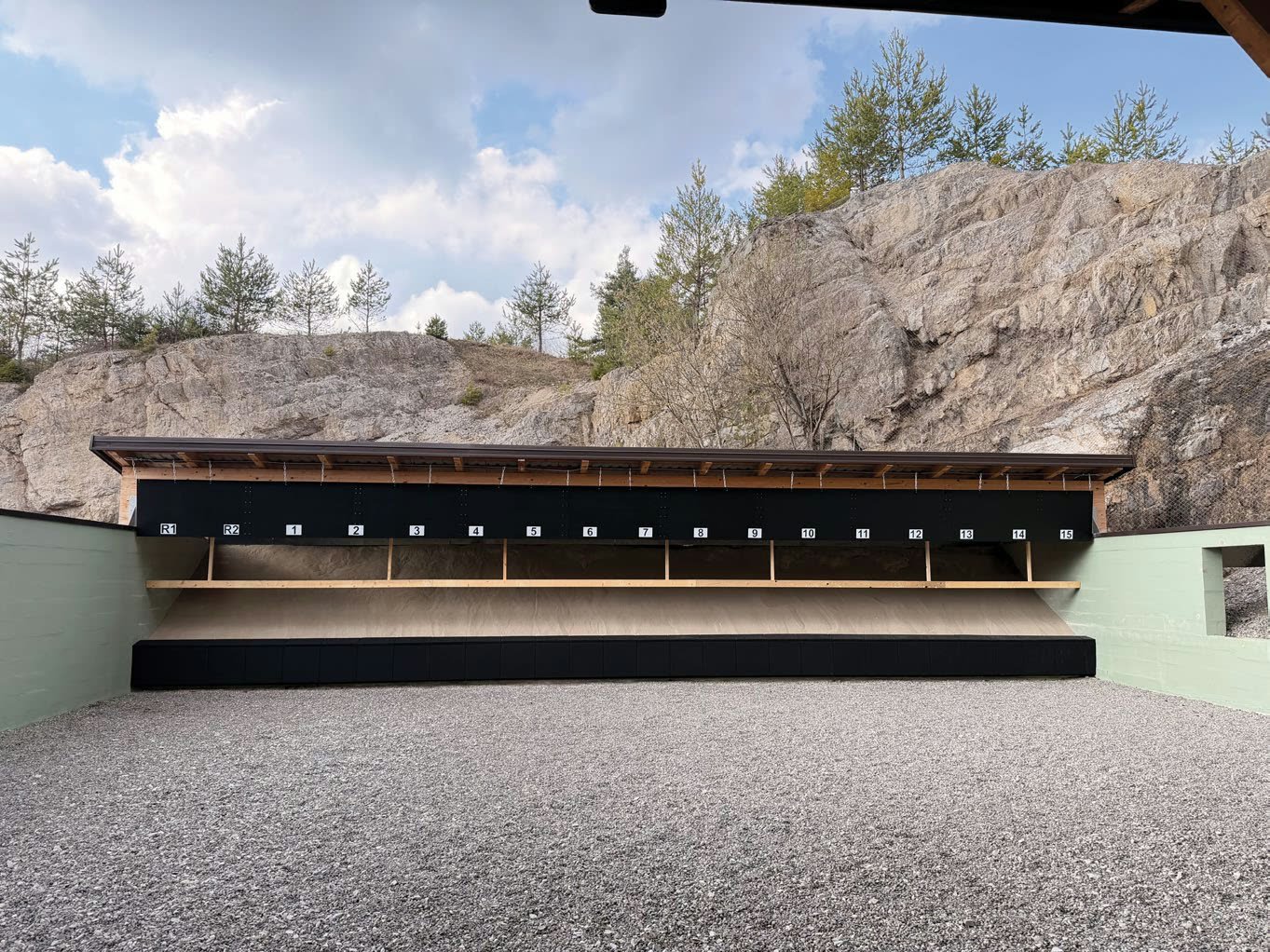
A continuous course of blocks runs along the base of the backstop, directly under the target line, where most rounds land. Example: a 15-lane outdoor range. The blocks resist repeated impacts, moisture and weather.
Rubber block trap, steel trap or clearing barrel?
“Bullet trap” is used for four different products. Match the term to the job:
| Type | Working principle | Typical use | Where to read more |
|---|---|---|---|
| Rubber block trap with steel backing | Rubber decelerates and holds the projectile, steel contains it; lead stays in the rubber until reclamation | Range backstops, indoor and outdoor | This page |
| Steel deflection trap | Angled plates deflect rounds into a collection chamber; airborne lead dust from impact has to be managed | Backstop zone only; compact, very long service life | Rubber vs steel |
| Clearing barrel (weapon clearing station) | A compact rated device the muzzle points into while loading and unloading | Armouries, police stations, checkpoints | Clearing barrels |
| Mobile test range | Free-standing steel unit that fragments and collects test shots | Gunsmiths, test firing | Mobile ranges |
Questions about bullet traps
What is a bullet trap on a shooting range?
The structure behind the targets that stops every round fired down range. In a rubber trap, 200 mm ballistic rubber blocks absorb and hold the projectile without ricochet, and an armoured steel plate behind them contains it. In VPAM ARG tests with calibres from 9×19 to 7.62×51 NATO no shot ricocheted and every projectile was stopped.
How thick must the steel backing plate be?
We size it by the projectile’s kinetic energy, to the background plate VPAM ARG uses when testing a lining: a 6 mm armoured plate for energies up to 1,500 J, which covers 9×19 mm pistol rounds, and a 10 mm plate above 1,500 J, which covers 7.62×39, 5.56×45 and 7.62×51 NATO. In the Royal Military Academy test the 500 HB plate stayed intact.
How many rubber blocks does a bullet trap need?
Four per square metre of trap face, because each BRB-200 block measures 500 × 500 mm. At about 42.5 kg per block that is roughly 170 kg per square metre before the steel backing. Send the width and height of the trap face and we calculate the block count and the delivery weight.
Is a rubber trap or a steel trap better?
It depends on the range. Rubber stops ricochet back to the firing line, dampens noise and keeps lead inside the material; steel deflection traps are compact and last very long, but they are noisier and every weld or joint is a ricochet risk if the plate geometry is wrong. Our comparison with the test data: ballistic rubber vs steel bullet trap.
What does a rubber bullet trap cost?
Our blocks are priced in euro on request, per project. As a public reference, US suppliers list ballistic blocks at about $115 to $185 each, roughly $3,500 to $4,500 per m³ (July 2026), before transatlantic freight and EU import duty. We ship from Lithuania within the EU, with no import duty.
Request a bullet trap specification
Send the calibres fired, indoor or outdoor, and the width and height of the trap face. We return the block count, the backing-plate bracket for your energies and a quotation, with the test reports for your tender file.
Request a QuoteEmail: info@bullettrapbaltic.com · Phone: +370 682 38746