
Shooting range equipment: what a range needs, zone by zone
An indoor or outdoor shooting range needs equipment in eight zones: a bullet trap or backstop, anti-ricochet lining on walls and ceiling, baffles, a firing-lane floor, a weapon clearing area with clearing barrels, targets, and, where the building itself needs protecting, bullet-resistant shutters. BulletTrap Baltic supplies all eight from Lithuania across the European Union, for calibres from .22 LR to .50 BMG.
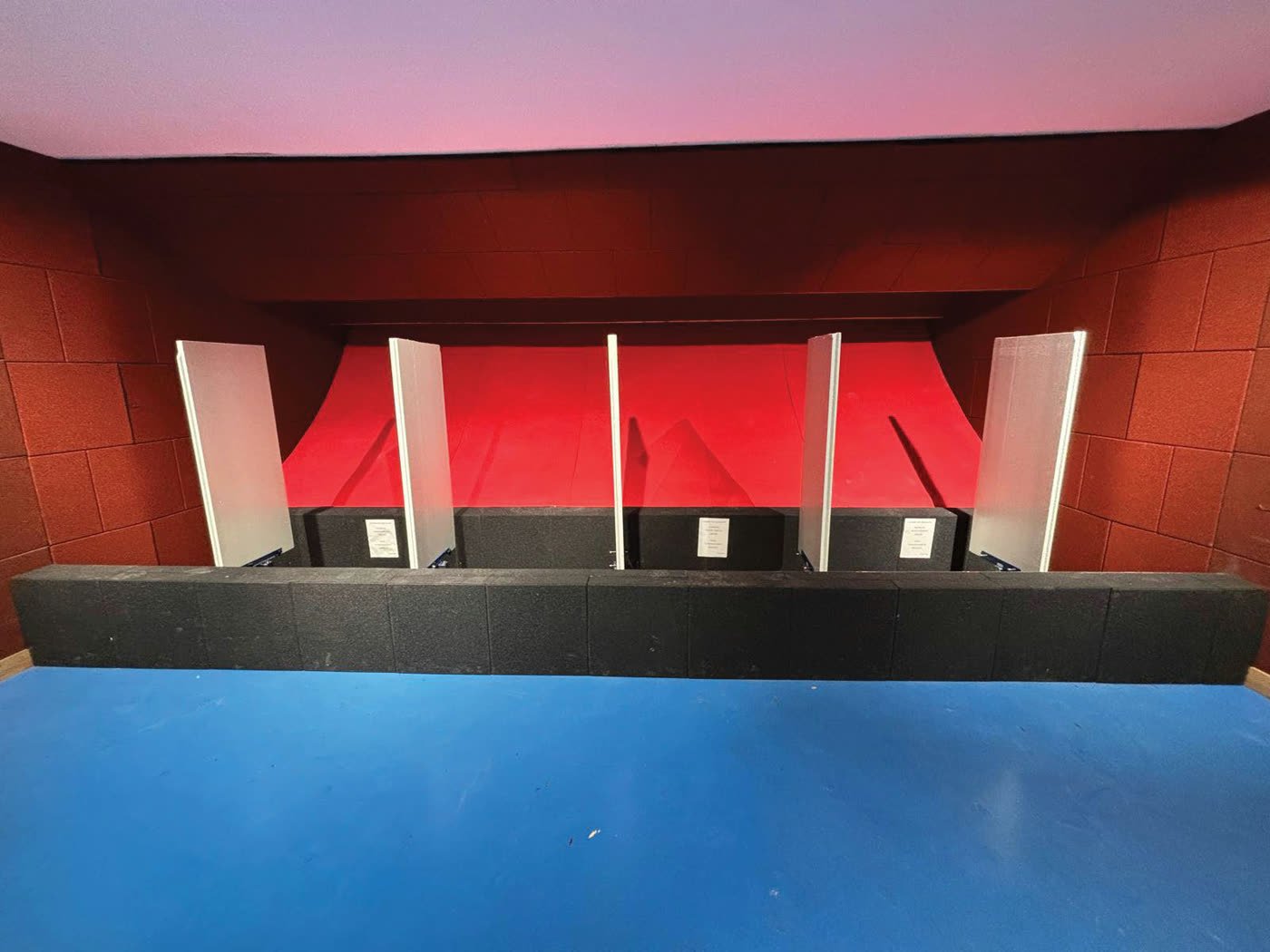
Indoor range built with this rubber system: walls and ceiling clad in anti-ricochet tiles, ballistic rubber blocks forming the trap behind the target line. Page updated 5 October 2026.
What equipment does a shooting range need?
Each zone below lists what it does, the product we supply for it and the figures you need for a specification. Follow the link for full data, test reports and drawings.
Bullet trap and backstop
Stops every round fired down range. On indoor and outdoor ranges this is a face of ballistic rubber blocks in front of an armoured steel plate; rubber alone is not a stand-alone trap.
Walls and ceiling lining
Anti-ricochet tiles cover every hard surface a stray round can reach, so a projectile stays in the tile instead of bouncing back to the firing line.
Baffles and lane dividers
Overhead baffles and side dividers keep rounds inside the range envelope. They are clad in the same anti-ricochet tiles as the walls.
Firing lane floor
The floor between the firing line and the trap takes misses and low shots. Large-format tiles keep joints few on big areas, indoors and outdoors.
Weapon clearing area (clearing barrels)
Where weapons are loaded, unloaded and checked, a clearing barrel (weapon clearing station) catches an accidental discharge. It is the first item in armouries, police stations and checkpoints.
Targets and target systems
Steel and moving targets for static drills, reaction training and realistic threat movement, controlled over Wi-Fi.
Mobile and test ranges
For testing weapons and ammunition without a permanent range: free-standing Hardox 500 units that fragment and collect the projectile.
Building protection
Armouries, police buildings and ranges in public buildings protect windows, doors and issue hatches with bullet-resistant roller shutters, closed on alarm or out of hours.
Ventilation, lighting and acoustics
Lead-fume extraction, range lighting and sound insulation are designed by the building engineer for each site; we do not supply them. In a fit-out project we coordinate the ballistic package with that design.
Which equipment does each type of facility need?
The zones a site needs depend on what is fired there and who uses it. Typical combinations:
| Facility | Equipment it needs | Where to start |
|---|---|---|
| Police armoury or checkpoint | Clearing barrel at the issue point (BC-1, or BC-2 ARMY if .50 BMG is present), bullet-resistant shutters on the issue hatch and ground-floor openings | Which clearing station → |
| Indoor pistol range | Rubber block trap with steel backing, 40 mm tiles on walls, ceiling and baffles, lane floor, stationary and turning targets, clearing station at the entry | Ballistic rubber → |
| Rifle or military training range | Block backstop with armoured steel backing, 45 mm tiles, BC-2 ARMY clearing stations, moving target systems | Rubber vs steel trap → |
| CQB shoot house | Full tile envelope on walls, ceiling and floor, turning and moving targets | Target systems → |
| Gunsmith or test workshop | Mobile test range BC7-GM or BC8-Shot, clearing station for function checks | Mobile ranges → |
| Bank, court or government building | Bullet-resistant roller shutters on windows, doors and counters | Roller shutters → |
Range safety rules are national. For Latvia and Estonia we have already mapped the requirements; see range design and tender support.
Questions buyers ask
What equipment does an indoor shooting range need?
A bullet trap or backstop behind the targets, anti-ricochet lining on walls and ceiling, baffles, a firing-lane floor, a weapon clearing station at the entry, and targets. Ventilation, lighting and acoustics come from the building design. BulletTrap Baltic supplies the ballistic part, from rubber blocks and tiles to clearing stations and targets.
Rubber or steel bullet trap: which should I choose?
Rubber blocks absorb the round quietly and stop ricochet back to the firing line; a steel plate behind them contains the projectile. Steel traps deflect rounds along angled plates into a collection chamber, and lead dust from impact has to be managed. Our comparison uses 67 instrumented shots from the Royal Military Academy: rubber vs steel.
Which clearing barrel does a police armoury need?
Match the calibres present on site. The Bullet Crusher BC-1 covers .22 LR to .338 Lapua Magnum at 11,000 J; the BC-2 ARMY covers up to .50 BMG at 17,000 J and has NATO stock number 1095-16-008-5453. Weapons with lights or lasers need the BC-1 Tactical with its 98 mm inlet.
How is shooting range equipment bought in a public tender?
Range equipment is usually procured under CPV 35210000 (targets and bullet traps), with design under CPV 71000000 and defence-site works under CPV 45222200. We supply the tender pack: test reports quoted by number and date, CE marking, fire classification and quality certificates. Details in our tender and CPV guide.
Where do you deliver, and how are prices set?
We ship from Lithuania to Latvia, Estonia and the rest of the European Union, with no import duty and the shortest lead times in the Baltic states. Targets have list prices from €250. Rubber, clearing stations and shutters are quoted per project against your drawings and calibres.
Send us your range
Tell us the calibres fired, indoor or outdoor, the range dimensions and the zones you need. We reply with a specification and a quote for each zone, plus the documents for your tender file.
Request a QuoteSupplier: MB Murakana (BulletTrap Baltic), Sudervės g. 12-3, Avižienių k., LT-14192 Vilniaus r., Lithuania
Email: info@bullettrapbaltic.com · Phone: +370 682 38746