
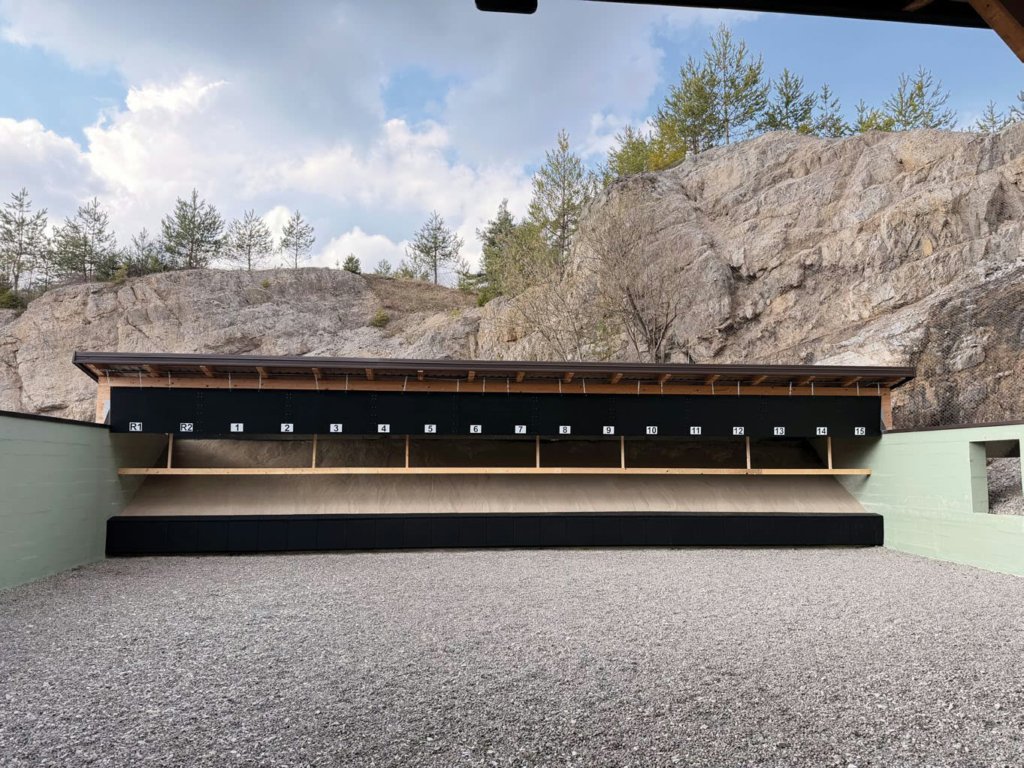
For targets and bullet traps the code is CPV 35210000 — Targets for shooting practice. If the same procedure also covers building or rebuilding the range itself, it usually sits under 45222200 (engineering works for military installations) or 45000000 (construction works), with 71000000 for the design and supervision services. The documentation a Baltic contracting authority expects from the supplier side is consistent across the three countries: third-party ballistic test reports, CE and declaration-of-performance documents, fire classification for indoor work, the manufacturer’s quality certification, NSN and NCAGE references where the item is catalogued, and dated technical datasheets with weights.
Start from the CPV code, because it decides what you will find
The CPV code is the practical entry point to this market. It determines how a notice is classified, which suppliers see it, and — from the buyer’s side — how the object of the contract is framed. Range equipment and range construction are procured under different codes, and searching only one of them will hide half of the market from you.
| CPV code | What it covers | Typical use |
|---|---|---|
| 35210000 | Targets for shooting practice — the code that covers targets and bullet traps | Supply contracts for targets, target systems, bullet traps and ballistic backstop material |
| 45222200 | Engineering works for military installations | Construction or reconstruction of a military or defence-league shooting range |
| 45000000 | Construction works (the top-level construction code) | Broader building contracts where the range is part of a larger complex or facility |
| 71000000 | Architectural, construction, engineering and inspection services | Design work, technical documentation and author supervision for a range project |
A single range project frequently runs as several separate procedures under different codes: design under 71000000, civil works under 45222200 or 45000000, and equipment under 35210000. Suppliers who watch only the equipment code miss the works notices where the equipment is specified.
Lithuania: CVP IS, and the vocabulary that finds notices
Lithuanian public procurement runs through CVP IS at cvpp.eviesiejipirkimai.lt, with above-threshold procedures also published on TED. Search in Lithuanian, not English: the working terms are šaudykla (shooting range), šaudyklos statyba and šaudyklos įrengimas (range construction and fitting out), kulkų gaudyklė (bullet trap) and taikiniai (targets).
A concrete example of how these procedures appear: in 2017 the Lithuanian police anti-terrorist operations unit “Aras” tendered the construction of a combat training complex including a shooting range in Vilnius, under CPV 45000000. That is a works procedure — but the ballistic lining and trap specification lives inside it, which is exactly why an equipment supplier needs to read works notices too.
Latvia: EIS and IUB, with a multi-site programme running
Latvian notices are published through the EIS electronic procurement system and the IUB procurement monitoring bureau. The Latvian search terms are šautuve (shooting range), šautuves izbūve (range construction), poligons (polygon or training area), mērķi (targets) and šāviņu uztvērējs (projectile catcher).
Latvia is currently the most active of the three on range infrastructure. VAMOIC — the State Defence Military Objects and Procurement Centre — is running a multi-site range programme covering Sēlija, Mežaine/Skrunda, Lāčusils and Ādaži. One published example of how that programme reaches the market: VAMOIC tendered the design and author supervision for a 1500 m range at the Lāčusils polygon. Design procedures like that one are worth watching even if you only supply material, because the specification written at design stage determines what can be offered later.
Estonia: riigihanked, RKIK and Kaitseliit
Estonian notices are published on the state register at riigihanked.riik.ee. The relevant terms are lasketiir (shooting range), lasketiiru rekonstrueerimine (range reconstruction), sihtmärgid (targets) and kuulipüüdja (bullet catcher).
Two buyers dominate. The Estonian Centre for Defence Investment (RKIK) procures targets and range works regularly — in 2024 it bought car-wreck targets under CPV 35210000, a contract awarded to Grenader Grupp OÜ at EUR 17,460. The Defence League (Kaitseliit) procures range infrastructure in its own right: in 2023 it tendered the reconstruction of the Karujärve shooting range on Saaremaa under CPV 45222200. Between them, those two examples show the pattern across the whole region — small, frequent equipment contracts under 35210000, and larger, less frequent works contracts under 45222200.
The documentation pack a supplier should be able to hand you
Assume nothing will be produced later that cannot be produced now. A supplier who intends to bid seriously in a Baltic procedure should already hold, in a form that can be attached to an offer:
- Third-party ballistic test reports, quoted by report number and date, from a named accredited laboratory — not a self-declaration or a brochure extract.
- CE marking and declaration of performance for the construction-product characteristics of the material.
- Fire classification under EN 13501-1, which the building authority will ask for in any indoor range.
- Emission testing where indoor air quality is assessed — an AgBB VOC result, for example.
- Manufacturer quality certification, typically ISO 9001, covering the production of the item offered.
- NSN and NCAGE references where the item is catalogued in the NATO supply system — useful for defence buyers, though these are identification and logistics references, not test results.
- Dated technical datasheets, with dimensions, weight per unit and weight per square metre, so the works contractor can plan structure and handling.
What we can put into that pack is set out in detail in our guide to verifying a ballistic equipment supplier: two reports from the Department of Weapon Systems and Ballistics of the Royal Military Academy in Brussels, an ISO 17025 accredited laboratory with BELAC accreditation No. 273-TEST and VPAM membership — report ES-230403 for tiles and ES-240131 for blocks, the latter run to VPAM ARG Fassung 3 — plus CE marking to EN 14041, EN 13501-1 fire classification with a flame-retardant version available, and a passed AgBB VOC test. Product detail sits on the ballistic rubber blocks and anti-ricochet tiles page. For the Bullet Crusher unloading devices the manufacturer, Dependable Solutions s.r.o. in the Czech Republic, is certified to ISO 9001:2015 and registered under NATO NCAGE 6916G, with NATO Stock Numbers on selected models — the BC-2 Army is NSN 1095-16-008-5453 — and confirmed NIJ Level IV ballistic resistance on selected models.
Lead time and delivery: weight is the variable that surprises people
Ballistic rubber is not a light material, and in a tender that is a scheduling fact rather than a detail. A single 500x500x200 mm block weighs about 42.5 kg, and tile cladding runs 34 to 39 kg per square metre. A modest indoor range lining is therefore measured in tonnes, and freight cost and transit time scale directly with that mass.
This is where the supplier’s location does real work. Supply from within the EU means no import duty and no transatlantic ocean freight in the delivery schedule — the difference is not only price but the number of weeks between award and installation, which matters when a works contract has a fixed completion date. We manufacture in the EU and ship from Lithuania to Lithuania, Latvia and Estonia. The cost consequences of that are set out in our comparison of ballistic rubber and steel bullet traps.
Two points for the technical specification. State the calibres actually fired and the geometry of the space rather than a brand name, and ask for unit and area weights in the offer — the works contractor needs them to check structural loading and access before delivery day, not after.
Preparing a tender or an offer?
Send us the technical specification, the drawings and the calibres. We will return a specification-matched quotation together with the test reports, CE and fire documentation and manufacturer certifications in a form you can attach to a procurement file. Quotes across the European Union; prices on request.
Request a quoteBulletTrap Baltic — MB Murakana, Sudervės g. 12-3, Avižieniai, LT-14192 Vilnius district, Lithuania (EU)
info@bullettrapbaltic.com · +370 682 38746
Frequently asked questions
Which CPV code applies to bullet traps and shooting range targets?
CPV 35210000, “Targets for shooting practice”, is the code that covers targets and bullet traps. Where the procedure also covers building or rebuilding the range, contracting authorities commonly use 45222200 for engineering works for military installations, 45000000 for construction works generally, and 71000000 for the architectural and engineering services such as design and author supervision.
Where are shooting range tenders published in the Baltic states?
Lithuania publishes through CVP IS at cvpp.eviesiejipirkimai.lt, Latvia through the EIS electronic procurement system and the IUB procurement monitoring bureau, and Estonia through the state register at riigihanked.riik.ee. Above-threshold procedures in all three countries also appear on TED, the EU-wide portal. Notices are written in the national language, so searching in Lithuanian, Latvian or Estonian returns far more than searching in English.
Who buys shooting range equipment in the Baltics?
In Estonia the main buyers are the Centre for Defence Investment (RKIK), which bought car-wreck targets under CPV 35210000 in 2024 in a contract awarded to Grenader Grupp OU for EUR 17,460, and the Defence League (Kaitseliit), which tendered the reconstruction of the Karujarve shooting range on Saaremaa in 2023 under CPV 45222200. In Latvia, VAMOIC (the State Defence Military Objects and Procurement Centre) is running a multi-site range programme covering Selija, Mezaine/Skrunda, Lacusils and Adazi. In Lithuania, police and defence bodies procure range works – the anti-terrorist unit Aras tendered a combat training complex with a shooting range in Vilnius in 2017 under CPV 45000000.
What documents should a supplier attach to a shooting range tender offer?
Third-party ballistic test reports from a named accredited laboratory, quoted by report number and date; CE marking and the declaration of performance for the construction-product characteristics; EN 13501-1 fire classification for indoor work; emission testing such as AgBB where indoor air quality is assessed; the manufacturer’s quality certification, typically ISO 9001; NSN and NCAGE references where the item is catalogued for NATO supply; and dated technical datasheets stating dimensions and weights.
Why does supplier location affect the delivery schedule for ballistic rubber?
Because the material is heavy. A single 500x500x200 mm ballistic rubber block weighs about 42.5 kg and tile cladding runs 34 to 39 kg per square metre, so even a modest range lining is measured in tonnes. Freight cost and transit time scale with that mass, and supply from outside the EU adds import duty and ocean freight to both the price and the schedule. For a works contract with a fixed completion date, the number of weeks between award and delivery is often the deciding factor.