
Before you accept any ballistic performance claim, demand three things. First, an accredited third-party test report — a document from a named laboratory with an accreditation number, not a self-declaration on the manufacturer’s letterhead. Second, the standard or protocol the test was run to, so the result is comparable to something. Third, product conformity marking for the way the material will actually be used in the building — CE marking, fire classification, emissions. Everything else on a supplier’s certificate wall is context. If those three are missing, you have marketing, not evidence.
Why this matters more here than in most categories
Ballistic products fail quietly. A rubber tile that lets a round skip off a wall does not announce itself in a datasheet; a backstop that was never tested at the calibre you actually shoot looks identical to one that was. The buyer normally cannot verify performance on delivery, and by the time a problem shows up, someone is standing in front of it.
That asymmetry is exactly why the paperwork carries the weight. It is also why so much of the paperwork circulating in this market is presented in a way that suggests more than it proves. The point of this article is not to argue that our documents are better than anyone else’s — it is to give a procurement officer a way of reading any supplier’s evidence, including ours, and knowing what each piece does and does not cover.
What each credential actually tells you
Most certificates in this industry are legitimate documents that are simply quoted out of scope. A quality certificate gets used as a ballistic claim; a supply catalogue number gets used as a test result. The table below separates the two columns that matter.
| Credential | What it proves | What it does NOT prove |
|---|---|---|
| ISO 17025 accredited lab report | An independent laboratory, formally assessed as competent to run this type of test, measured a specific sample and published the result with an identifiable report number | That every production batch matches the tested sample, or that the tested configuration is the one you are being quoted |
| VPAM membership / ARG protocol | That the test followed a published, recognised European ballistic protocol with defined calibres, distances and pass criteria, rather than an in-house method | A performance level by itself. “Tested to VPAM ARG” is meaningless without the report stating which calibres, which angles and what the outcome was |
| CE marking to EN 14041 | The product is declared as a resilient floor covering placed on the EU market, with harmonised characteristics declared by the manufacturer | Any ballistic property whatsoever. EN 14041 is a construction-product standard, not a ballistic one |
| EN 13501-1 fire classification | The material’s reaction to fire has been classified by test, which is what a building authority or fire inspector will ask for in an indoor range | Fire resistance of the structure, or that the classified version is the one on your quotation – versions differ |
| AgBB VOC emission test | The material was assessed against the German AgBB scheme for volatile organic compound emissions into indoor air | Anything about lead, combustion products or range ventilation – it is an emissions test on the material as supplied |
| ISO 9001 | The manufacturer runs a certified quality management system: documented processes, traceability, corrective actions | Any product performance at all. A factory can be ISO 9001 certified and consistently produce a product that has never been ballistically tested |
| NATO NCAGE / NSN | The manufacturer is registered as a supplier entity, and that specific item is catalogued in the NATO supply system under its own stock number | That the item passed a ballistic test. Cataloguing is a logistics and identification function, not a performance endorsement |
| NIJ Level IV ballistic resistance | The specified component was tested to a defined armour-resistance level against a defined threat | That the whole assembly is Level IV. The level normally applies to a stated part of the product – ask which one |
None of these credentials is weak or misleading in itself. The failure mode is scope creep: a genuine certificate quoted as evidence for a claim it was never designed to support.
Red flags in a datasheet
You can screen out most unsupportable claims without any ballistic expertise, simply by looking for what is absent.
- A performance claim with no report number. “No ricochet” or “stops rifle rounds” with nothing to look up. Real tests produce numbered documents.
- No laboratory named. “Independently tested” and “third-party verified” are not laboratories. Ask which one, and for its accreditation number.
- No standard cited. If no protocol is named, nobody can tell you what the test proved, and no two suppliers’ claims can be compared.
- “Tested up to X joules” with no protocol. Energy alone says nothing: the same energy from a pistol round and a rifle round behaves completely differently against rubber, and the impact angle changes the outcome more than the energy does.
- No issue date on the datasheet. An undated document cannot be matched to a test campaign, a product revision or a batch.
- A certificate that is not in the product’s name. Group-level certificates and certificates for a different model are common; check the product designation on the face of the document.
- Refusal to release the report itself. A summary line in a brochure is not a report. If the full document cannot be shared with a public buyer under an NDA, ask why.
What to ask for, verbatim
This is a short checklist a procurement officer can paste into a clarification request or an RFI. It is deliberately neutral — send it to every bidder, including us.
- Name the testing laboratory, its accreditation body and its accreditation number.
- Provide the full test report, with its report number and date, not an extract or a summary.
- State the standard or protocol applied and the version or edition used.
- List the calibres tested, the projectile types, measured velocities and impact angles.
- State the exact sample configuration tested: dimensions, thickness, and any backing plate used.
- Confirm in writing that the product offered is the product tested, or describe every difference.
- Provide the declaration of performance and CE marking documentation for the construction-product characteristics.
- Provide the fire classification and confirm which product version it applies to.
- Provide the manufacturer’s quality certification and, where applicable, NCAGE and stock numbers.
- Provide dated technical datasheets, with weight per unit and per square metre.
What we put on the table
Applying the same checklist to ourselves, this is the evidence we can hand over — and the scope of each item.
The ballistic rubber blocks and anti-ricochet tiles were tested by the Department of Weapon Systems and Ballistics of the Royal Military Academy in Brussels, an ISO 17025 accredited laboratory holding BELAC accreditation No. 273-TEST and a member of VPAM. There are two reports, and we quote both by number:
- ES-230403 (tiles, 3 April 2023) — 39 instrumented shots, establishing the ricochet-threshold angle for each calibre rather than a single pass or fail.
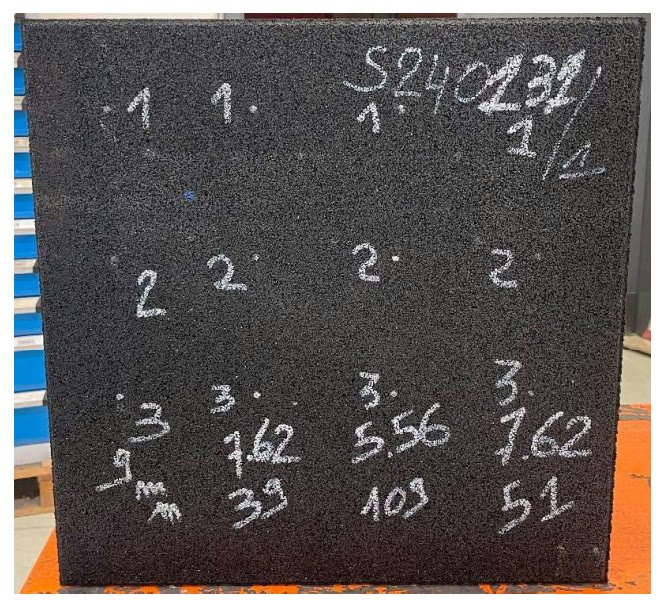
- ES-240131 (block, 2 February 2024) — run to VPAM ARG Fassung 3, three shots per calibre at 90 degrees, with no ricochet recorded for 9×19 mm DM41, 5.56×45 mm SS109, 7.62×39 mm M43 or 7.62×51 mm DM111. With an armoured 500 HB steel backing plate the projectile was contained and the plate remained intact. VPAM ARG sets that backing plate by energy: 6 mm up to 1500 J, 10 mm above 1500 J.
Note what that second report does not claim: the block is an energy-absorbing front layer, not a standalone backstop. We explain the consequences of that in our comparison of ballistic rubber and steel bullet traps, and the full specifications are on the ballistic rubber blocks and anti-ricochet tiles page.
On the construction-product side, the rubber carries CE marking to EN 14041, an EN 13501-1 fire classification (Efl as standard, with a flame-retardant Cfl version available for stricter indoor requirements) and a passed AgBB VOC emission test. Those are the documents a building authority asks for; none of them says anything about ballistics, and we do not present them as if they did.
For the Bullet Crusher unloading devices, the manufacturer is Dependable Solutions s.r.o. in the Czech Republic, certified to ISO 9001:2015 and registered under NATO NCAGE 6916G. Selected models carry NATO Stock Numbers — the BC-2 Army, for example, is NSN 1095-16-008-5453 — and selected models have confirmed NIJ Level IV ballistic resistance. The devices are made from Swedish Hardox steel. Read that as three separate facts: a quality system, a supply-catalogue listing, and a ballistic rating on specified models. Ask us which model carries which, and we will tell you in writing.
If you are preparing a tender rather than a direct purchase, the companion article on buying shooting range equipment in the Baltics covers CPV codes and the documentation pack in tender terms.
Ask us for the documents first
We will send the full Royal Military Academy test reports, the CE and fire documentation and the manufacturer certifications before you commit to anything. Send your calibres, drawings and intended use, and we will state plainly which evidence covers your case and which does not. We supply across the European Union from our base in Lithuania; tender documentation available.
Request the documentationBulletTrap Baltic — MB Murakana, Sudervės g. 12-3, Avižieniai, LT-14192 Vilnius district, Lithuania (EU)
info@bullettrapbaltic.com · +370 682 38746
Frequently asked questions
What is the single most important document to ask a ballistic equipment supplier for?
A full test report from an accredited third-party laboratory, quoted by report number and date, stating the standard applied, the calibres and velocities tested and the exact sample configuration. A summary line in a brochure, a self-declaration or a generic “independently tested” statement is not a substitute. If the supplier cannot name the laboratory and its accreditation number, treat the performance claim as unverified.
Does ISO 9001 certification mean a bullet trap has been ballistically tested?
No. ISO 9001 certifies a quality management system — documented processes, traceability and corrective actions at the manufacturer. It says nothing about how the product performs against a projectile. A manufacturer can hold valid ISO 9001 certification and produce a product that has never been ballistically tested. Ballistic performance requires a separate test report from a competent laboratory.
Does a NATO Stock Number prove ballistic performance?
No. A NATO Stock Number means the item has been catalogued for supply within the NATO system and can be identified and ordered consistently. It is a logistics and identification function, not a performance endorsement. The same applies to an NCAGE code, which identifies the supplier entity. Both are useful for procurement, but neither replaces a ballistic test report.
What does CE marking to EN 14041 cover on ballistic rubber?
EN 14041 is a harmonised construction-product standard for resilient floor coverings, so CE marking to it covers the declared characteristics of the material as a building product placed on the EU market. It does not cover any ballistic property. For indoor ranges it is usually accompanied by an EN 13501-1 fire classification and, where indoor air quality is assessed, a VOC emission test such as AgBB.
Which certifications does BulletTrap Baltic provide?
For the ballistic rubber: two test reports from the Department of Weapon Systems and Ballistics of the Royal Military Academy in Brussels, an ISO 17025 accredited laboratory with BELAC accreditation No. 273-TEST and VPAM membership — report ES-230403 for tiles and ES-240131 for blocks, the latter run to VPAM ARG Fassung 3. Plus CE marking to EN 14041, EN 13501-1 fire classification and a passed AgBB VOC emission test. For the Bullet Crusher unloading devices: manufacturer ISO 9001:2015, NATO NCAGE 6916G, NATO Stock Numbers on selected models and confirmed NIJ Level IV ballistic resistance on selected models.